Decentralized bandwidth marketplaces powered by blockchain are changing how internet capacity is shared. They solve privacy, censorship, and pricing issues found in traditional VPNs by using peer-to-peer networks, smart contracts, and tokenized payments. Instead of relying on centralized servers, users share bandwidth directly, earning cryptocurrency while maintaining privacy.
Key Takeaways:
Privacy Protection: Multi-hop routing and decentralized nodes prevent tracking and data logging.
Censorship Resistance: Traffic routed through global nodes bypasses geo-restrictions and government blocks.
Fair Pricing: Pay-as-you-go models replace fixed fees, saving costs for light users and rewarding contributors.
Earn While Sharing: Platforms like MASQ allow users to earn tokens by sharing unused bandwidth.
In short, blockchain-based solutions like MASQ offer a secure, private, and flexible way to access the internet while addressing the flaws of conventional bandwidth services.
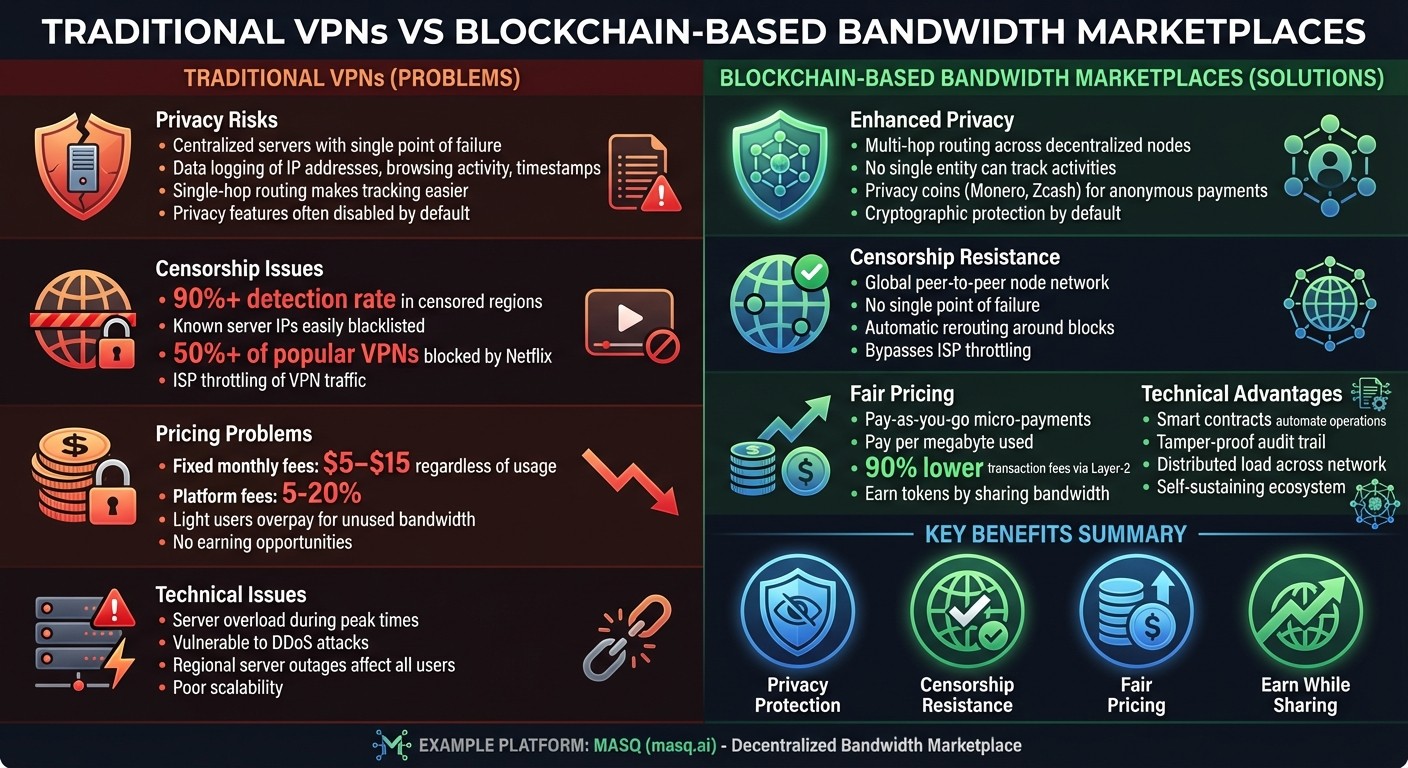
Traditional VPNs vs Blockchain Bandwidth Marketplaces Comparison
Problems with Traditional Bandwidth Sharing
Privacy Risks and Centralized Surveillance
When using centralized VPNs, all your data is funneled through a single server, which creates serious privacy concerns. Essentially, the VPN provider has access to the very information you're trying to keep private from your ISP - your IP address, browsing activity, and connection timestamps.
This setup is far from secure. Many providers log your data, and these logs can end up in the wrong hands - whether through hacking, being sold to third parties, or handed over to authorities via legal demands. On top of that, traditional VPNs often rely on single-hop routing, making it easier for trackers to trace your activity. Alarmingly, some services don’t even enable privacy features by default, leaving users vulnerable unless they manually adjust their settings.
Censorship and Geo-Restrictions
In heavily censored regions, governments and ISPs deploy deep packet inspection to detect and block common VPN protocols like OpenVPN and IKEv2. Detection rates in these areas can exceed 90%, making it incredibly difficult to maintain access.
Because traditional VPNs route traffic through known server IPs, blacklisting becomes a simple task. In fact, over half of the most popular VPNs struggle to bypass Netflix geo-blocks due to frequent IP blacklisting. Additionally, ISPs often throttle VPN traffic to enforce geo-restrictions, further limiting access to content and services that should otherwise be available.
Economic and Technical Inefficiencies
Traditional VPNs typically charge fixed monthly fees ranging from $5 to $15, regardless of how much or how little you actually use them. This means light users often overpay for unused bandwidth that goes to waste. At the same time, providers invest heavily in centralized servers, which are costly and often fail to scale effectively. Platform fees, which can range from 5% to 20%, only add to these expenses.
These centralized systems also create performance issues. During peak times, servers struggle to keep up, leading to streaming delays, gaming lag, and overall slow speeds. On top of that, they're highly vulnerable to DDoS attacks and regional server outages. If the single server you rely on goes down, everyone connected to it loses access. These flaws underscore the need for a decentralized solution, something blockchain technology is well-positioned to address.
How Blockchain Changes Bandwidth Marketplaces
Decentralized Marketplaces and Smart Contracts
Blockchain technology eliminates the need for middlemen by leveraging smart contracts that connect bandwidth providers directly with users. These contracts automate tasks like reserving bandwidth, verifying delivery, and releasing payments - all without human involvement or oversight from a central authority. Plus, they create a tamper-proof audit trail that anyone can access and review. A great example of this is the Theta Network, which uses smart contracts to manage video streaming across thousands of devices. By doing so, it bypasses traditional CDN providers and ensures that every participant gets compensated fairly. This approach introduces efficient, token-based systems that are reshaping how bandwidth is shared.
Tokenized Incentives and Micro-Payments
With blockchain, sharing unused bandwidth becomes a way to earn cryptocurrency tokens, with rewards based on factors like connection speed, uptime, and data volume. This allows for pay-as-you-go micro-payments, even down to fractions of a cent per megabyte. Instead of locking users into plans that cost $5 to $15 a month - regardless of whether they use 1GB or 100GB - blockchain networks charge only for the bandwidth actually consumed. To make this even more cost-effective, Layer-2 solutions handle micro-transactions off-chain, cutting processing fees by up to 90%. This structure benefits everyone: light users avoid overpaying, heavy users pay proportionally, and providers are rewarded based on their contributions.
Better Privacy and Security
Blockchain also bolsters privacy by decentralizing its architecture, ensuring no single entity can track or monitor users' activities. When paired with privacy-focused cryptocurrencies like Monero or Zcash, the system takes anonymity to the next level. These coins use advanced techniques like ring signatures and stealth addresses to obscure transaction details, making it nearly impossible to trace payments back to a specific individual or browsing activity. While the blockchain records that bandwidth was shared and payments were made, cryptographic methods ensure that these transactions remain anonymous and disconnected from your identity.
Key Benefits of Blockchain-Based Bandwidth Sharing
Better Privacy for Everyday Tasks
Decentralized bandwidth networks offer a significant privacy boost by masking your real IP address through multi-hop routing and peer-to-peer sharing. Instead of funneling all your traffic through a single company's server, as traditional VPNs do, blockchain-based systems distribute your connection across independent nodes worldwide. This makes it nearly impossible for any single entity to track your online activities - whether you're streaming your favorite shows, gaming online, or participating in remote work meetings.
For users in the U.S. working from home, this setup anonymizes connections to cloud tools like Google Workspace and Microsoft Teams, shielding you from corporate IP tracking or ISP monitoring. It also enhances streaming quality and reduces gaming latency. On top of that, encrypted peer-to-peer protocols ensure that your browsing, transactions, and bandwidth usage are entirely disconnected from your personal identity.
These privacy-focused features also play a critical role in combating censorship.
Censorship Resistance and Internet Freedom
Blockchain-powered networks are built to resist censorship by eliminating single points of failure. This makes it much harder for governments or ISPs to block access to websites, social platforms, or streaming services. When your internet traffic is routed through multiple nodes across the globe, blocking a single server or IP range becomes ineffective because the network can simply reroute through other available peers. For U.S. users, this ensures continued access to information, even in the face of net neutrality issues, regional restrictions, or ISP throttling.
Thanks to the peer-to-peer design, even if specific nodes are targeted, the network as a whole remains operational. This is particularly valuable for accessing geo-restricted live sports, international news sources, or social media platforms during periods of strict content moderation - all while keeping your online activity private and secure.
Fair and Transparent Pricing
Beyond technical advantages, blockchain-based bandwidth sharing also changes the game when it comes to pricing. Smart contracts enable a pay-per-use model, eliminating the high fees (typically 5–20%) charged by centralized platforms. Instead of committing to traditional unlimited plans, users only pay for the bandwidth they actually consume, with all transactions transparently recorded on the blockchain.
What’s more, you can turn your unused bandwidth into income. Platforms like MASQ reward users with tokens based on their connection speed and uptime. These tokens can offset, or even exceed, your own usage costs. For U.S. households with high-speed internet, this creates a fair system where you only pay for what you use, while also earning rewards for contributing to the network.
Theta Network For Beginners Explained - A Step by Step Guide
The Role of Privacy Coins in Bandwidth Marketplaces
Privacy coins take the security and decentralization of blockchain technology a step further, offering enhanced protection for user transactions in bandwidth marketplaces.
Payment Anonymity and Confidentiality
Privacy coins like Monero and Zcash are designed to keep transaction details hidden. Unlike Bitcoin, where every transaction is publicly recorded, these coins use advanced techniques like ring signatures and zero-knowledge proofs to obscure key details such as the sender, receiver, and transaction amount. This means that when users purchase bandwidth, their identities and payment details remain completely private.
Protection Against Financial Surveillance
One of the standout benefits of privacy coins is their ability to counter financial surveillance. Traditional cryptocurrencies leave behind a transparent, traceable record on public blockchains. In contrast, privacy coins replace these traceable records with confidential transactions and unlinkable addresses. By leveraging cryptographic techniques, they reduce traceability to nearly zero. This level of security is especially important in decentralized bandwidth marketplaces, where users may be concerned about financial monitoring. With privacy coins, participants can engage in transactions without worrying about being tracked or monitored.
Support for High-Risk Users
Privacy coins are indispensable for users who face heightened risks from financial monitoring, such as activists, journalists, or whistleblowers. For these individuals, anonymity is not just a preference - it’s a necessity. Privacy coins allow them to securely and anonymously access bandwidth-sharing platforms without leaving behind a financial trail. For example, a journalist operating in a region with heavy censorship could use privacy coins to purchase bandwidth on a decentralized platform like MASQ. This ensures their connection remains private while their payment details stay hidden. When combined with multi-hop routing, this approach offers an even greater level of protection against tracking or blocking attempts.
Practical Benefits for U.S. Users
Blockchain-based bandwidth marketplaces are transforming how American households experience the internet, offering real-world improvements to online activities that matter most.
Streaming, Gaming, and Media Access
In the U.S., geo-blocks and ISP throttling during peak hours frustrate many users. Decentralized bandwidth networks solve these issues by routing traffic through globally distributed nodes. This approach bypasses regional blackouts for sports events and unlocks streaming libraries that might otherwise be unavailable. Plus, blockchain-secured dVPN channels ensure ISPs can’t detect or throttle 4K video streams or game downloads.
Take MASQ, for example. This platform allows users to access optimized network paths that bypass regional restrictions while keeping their activities private. It’s designed for bandwidth-heavy tasks like 1080p and 4K streaming, delivering premium speeds without buffering - even during prime-time hours. What’s more, users can earn MASQ tokens by sharing unused bandwidth from their home internet, which can then be used to pay for secure, private access while traveling.
Secure Remote Work and Cloud Tools
Remote workers face unique challenges, from ISP tracking to vulnerabilities on public Wi-Fi. A dVPN client protects sensitive tasks like email, video conferencing, file sharing, and browsing by routing them through encrypted channels. This ensures privacy and guards against network snooping or man-in-the-middle attacks.
For professionals handling confidential information, privacy coins offer an added layer of security. These coins allow bandwidth purchases without linking to personal financial accounts like credit cards. MASQ takes this a step further with multi-hop routing, which separates entry and exit nodes. This feature is invaluable for journalists, freelancers, and activists who rely on secure communications to maintain confidentiality.
Web3 and Decentralized Applications
Blockchain bandwidth marketplaces seamlessly integrate with Web3 wallets, enabling users to pay for connectivity using cryptocurrency. With automated smart contracts, these platforms support micro-payments for each gigabyte of data consumed, creating a true pay-as-you-go model without the high fees associated with traditional payment systems. This means you can manage your bandwidth spending from the same wallet you use for DeFi trading, NFT purchases, and other decentralized services.
MASQ merges a dVPN with a Web3 browser and built-in wallets, giving users a private and censorship-resistant way to explore decentralized applications. The platform natively resolves ENS domains and IPFS URLs, making it easy to access decentralized websites. With features like an ad blocker and a decentralized dApp store, U.S. users can dive into the full Web3 ecosystem without sacrificing privacy.
Tokenized micro-payments also help reduce costs. If you have a fast home internet connection, you can share unused bandwidth to earn tokens. These tokens can then be used to offset your own privacy expenses, creating a self-sustaining model that traditional services simply can’t replicate.
Conclusion
Blockchain-based bandwidth marketplaces bring a new level of privacy, transparency, and user control by removing the need for central gatekeepers. Instead of relying on a single company to manage your browsing data and payments, blockchain spreads control across multiple nodes and records activity on an unchangeable ledger. The result? A system that's resistant to censorship, fair, and built on trustless principles.
For users in the U.S., these technical features offer real-world benefits. Decentralized bandwidth networks help you avoid ISP throttling, unlock geo-restricted content, and secure your connection - all while keeping your IP address and payment details separate. With the added layer of privacy coins, you can pay for services or earn rewards without exposing your financial activity or browsing habits.
A great example of this approach is MASQ, which combines a decentralized VPN, multi-hop routing, a Web3 browser, built-in wallets, and token-based rewards for sharing bandwidth. This creates a sustainable ecosystem where privacy, censorship resistance, and user empowerment go hand in hand. On MASQ, you're not just a customer - you’re also a participant, managing your data and benefiting economically from what would typically go to a centralized provider.
Of course, challenges remain. User experience can be complex, and U.S. regulations around crypto payments are still evolving. But the direction is unmistakable. As platforms like MASQ make decentralized bandwidth tools as user-friendly as traditional apps, people will gain stronger privacy, broader internet access, and a fairer economic system. This transition represents a significant step toward greater digital freedom.
Whether you're streaming, working remotely, or diving into Web3, consider if your current tools meet your expectations for privacy, transparency, and control. Exploring a platform like MASQ is an easy first step toward reclaiming your online privacy and enjoying a more open internet.
FAQs
How does blockchain enhance privacy in sharing internet bandwidth?
Blockchain technology plays a key role in improving privacy when it comes to sharing internet bandwidth. By relying on decentralized systems secured through cryptography, it allows users to share their bandwidth anonymously, reducing the risk of personal data being exposed or collected.
Since blockchain removes the need for centralized intermediaries, it safeguards user identities while ensuring data remains intact and secure. This approach not only prevents unauthorized access but also creates a system where bandwidth transactions are both transparent and private, tackling many of the privacy challenges associated with traditional methods.
What are the advantages of using tokenized payments in decentralized bandwidth sharing?
Tokenized payments bring a new level of security, transparency, and efficiency to decentralized bandwidth sharing. By cutting out the middlemen, they reduce transaction costs and enable quicker, direct exchanges between users. Plus, participants are rewarded with tokens for sharing their bandwidth, encouraging a balanced and privacy-driven system.
This approach ties directly into blockchain's strengths - like improved privacy and trustless transactions - giving users more control over their online interactions while safeguarding their anonymity.
How do decentralized networks prevent censorship more effectively than traditional VPNs?
Decentralized networks tackle censorship by spreading data across a global web of nodes. Without a central server to target, no single authority can block or restrict access effectively. This structure makes censorship attempts incredibly difficult.
Traditional VPNs, on the other hand, depend on centralized servers. These can be pinpointed, monitored, or even taken offline, making them more vulnerable. Decentralized systems, however, provide a stronger layer of resilience and privacy, allowing users to browse freely and securely - even in areas with heavy censorship restrictions.