Decentralized VPNs (dVPNs) offer a new way to secure your online privacy by eliminating reliance on a single provider. Unlike conventional VPNs, which require trust in a central authority, dVPNs operate on peer-to-peer networks, making them harder to censor and more transparent. MASQ, with its "dMeshVPN", takes this concept further by using multi-hop routing, layered encryption, and a decentralized mesh network to ensure no single node can trace your data. Here's what you need to know:
Privacy: MASQ uses 3-hop routing and TLS encryption to protect your data, ensuring no logs are stored.
Transparency: Open-source code, public smart contracts, and real-time dashboards provide verifiable privacy claims.
Censorship Resistance: Peer-to-peer routing and disguised traffic make dVPNs harder to block compared to centralized VPNs.
Cost: MASQ offers a token-based system with subscriptions starting at $8/month, providing flexible payment options.
Quick Comparison:
Feature | Centralized VPNs | Decentralized VPNs (MASQ) |
|---|---|---|
Trust Model | Relies on a single provider | Distributed across nodes |
Data Privacy | Risk of logging | No logs, multi-hop routing |
Transparency | Limited | Open-source, public metrics |
Censorship | Easy to block | Harder to detect/block |
Infrastructure | Centralized servers | Community-operated nodes |
MASQ's decentralized approach shifts trust from providers to verifiable systems, offering a modern alternative to securing online privacy.
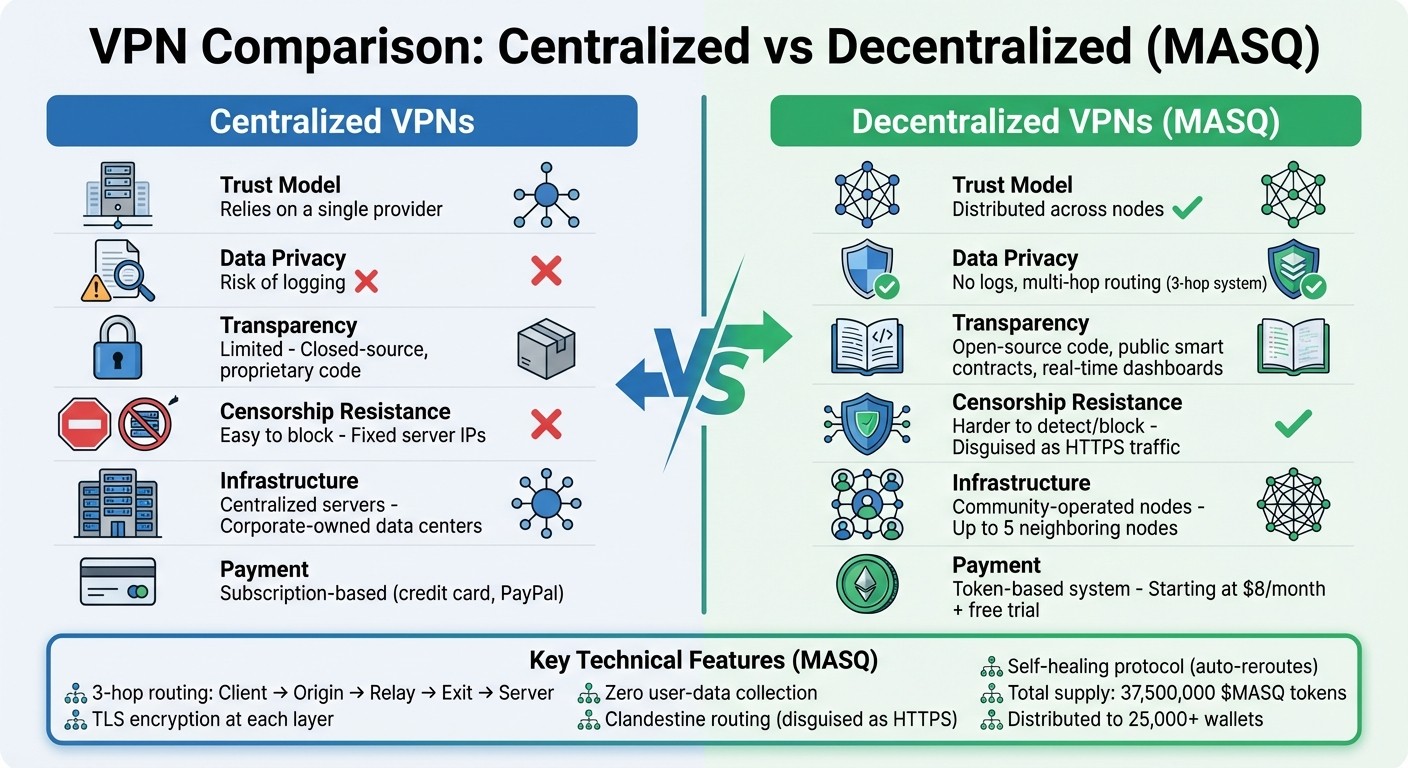
Centralized vs Decentralized VPN Comparison: Trust, Privacy, and Security Features
1. MASQ
Trust Models
MASQ takes a different approach to trust by using a decentralized mesh network called dMeshVPN, replacing the traditional single point of trust. Instead of relying on a central server, users connect to a network of up to five nearby nodes. Each node only knows its immediate neighbors, making it impossible for any one entity to trace traffic from its origin to its final destination.
Trust within the network is built using a Gossip protocol, where nodes verify each other's public keys to confirm their ability to route and pay for data. If a node goes offline, becomes congested, or acts maliciously, the network automatically reroutes traffic. Meanwhile, an Accountant Module tracks data exchanges, ensuring nodes don't exceed allowable debt. Nodes that violate these limits are banned, further strengthening the system. These measures collectively enhance MASQ's privacy and reliability.
Data Privacy
MASQ employs a 3-hop routing system (Client → Origin → Relay → Exit → Server) by default. Each hop uses layered encryption, and direct TLS handshakes between the browser and destination ensure that exit nodes cannot access unencrypted data.
According to MASQ Network, "zero MASQ user-data is ever collected". To maintain privacy, users can separate their activities into "Consuming" and "Earning" wallets. This setup ensures that consuming wallets remain anonymous and are excluded from Gossip records. Additionally, MASQ uses clandestine routing, disguising data packets as standard HTTPS traffic. This prevents ISPs or authorities from identifying or inspecting the data.
Transparency
MASQ reinforces user trust through a commitment to transparency. Its open-source Rust protocol, public smart contracts on Ethereum, Polygon, and Base, and a real-time Dune dashboard all provide insight into privacy claims and token metrics. For instance, an initial airdrop distributed tokens to over 25,000 wallets, helping establish the decentralized network. The total token supply is capped at 37,500,000 $MASQ tokens. Additionally, MASQ was funded by its community from the start, avoiding any centralized control.
Censorship Resistance
Unlike traditional VPNs that rely on centralized servers with fixed IPs - making them easy targets for blocking - MASQ operates on a decentralized mesh network. Its clandestine routing makes its traffic indistinguishable from regular HTTPS traffic, making it harder for ISPs or governments to detect and block. Even if some nodes are blocked, the network can dynamically reroute traffic, ensuring continued access and resilience against censorship.
2. Traditional VPNs
Trust Models
Traditional VPNs operate on a centralized structure, where a single provider's server is responsible for securing your connection. This setup means users must place complete trust in the provider. However, central servers can become targets for data requests from authorities or even external attacks. For most users, trust in these services often hinges on the provider's reputation and their claims of maintaining "no-logs" policies.
Data Privacy
Internet Service Providers (ISPs) can detect VPN usage by matching traffic to the IP addresses of known VPN servers. This makes VPN traffic more identifiable through techniques like data inspection, leaving it open to monitoring by malicious actors. Since traditional VPNs rely on a single connection point, their traffic patterns can become predictable and exposed over time.
This dependency on a centralized system raises broader concerns about data security and accountability.
Transparency
To address these vulnerabilities, many traditional VPN providers implement third-party audits and open-source initiatives to build user trust. Regular security and "no-logs" audits are conducted by firms like Deloitte, KPMG, Cure53, and Securitum. For instance, in April 2023, Swedish authorities raided Mullvad VPN's offices in Gothenburg but failed to seize any data due to Mullvad's minimal-data design. Similarly, Private Internet Access (PIA) has faced multiple U.S. subpoenas but has consistently been unable to produce user logs in court.
Some providers also open-source their client software, allowing public inspection, and use RAM-only servers to ensure no data is stored on hard drives. However, the industry’s growing consolidation - such as multiple VPN brands coming under the umbrella of companies like Kape Technologies - has raised skepticism among users.
Censorship Resistance
Traditional VPNs also struggle in regions with heavy internet restrictions. Their centralized server IPs are public, making them easy targets for blocking. Governments and ISPs often use deep packet inspection to detect VPN protocols, like OpenVPN, and blacklist those connections. Once server IPs are identified, blocking them becomes a straightforward task for authorities.
Busting Myths of Decentralized VPNs (Safing Interview)
Pros and Cons
Traditional VPNs require users to place their trust in a single provider, while MASQ's decentralized approach shifts reliance to verifiable code and a network of independent nodes. Here's a breakdown of how they compare in key areas like trust, privacy, and performance:
Feature | Traditional VPN | Decentralized VPN (MASQ) |
|---|---|---|
Trust Model | Centralized - relies on one provider | Distributed - verifiable code and independent nodes |
Data Privacy | Potential risk of centralized logging and data sharing | No centralized logs; uses multi-hop routing |
Transparency | Closed-source, proprietary code | Open-source code and infrastructure |
Censorship Resistance | Vulnerable to jurisdictional restrictions | Strong resistance through peer-to-peer networks |
Infrastructure | Operates on corporate-owned data centers | Powered by community-operated nodes |
Payment | Subscription-based (credit card, PayPal, etc.) | Free trial access and premium plans starting at $8/month |
These comparisons highlight some of the trade-offs, particularly when it comes to speed and cost, helping users make a more informed choice.
When it comes to performance, traditional VPNs often deliver steadier speeds, thanks to their professionally managed servers. On the other hand, decentralized networks like MASQ depend on individual nodes, meaning performance can vary. For instance, residential nodes typically offer speeds ranging from 10 Mbps to 40 Mbps.
Pricing models also differ. Traditional VPNs tend to charge flat monthly or annual fees. Decentralized solutions, however, often explore more flexible options. MASQ, for example, provides a free trial and premium subscriptions starting at $8 per month, with payment options that include both credit cards and cryptocurrency.
As Brien, CEO of URNetwork, aptly said:
"When someone says no logs, the right response is: show me the schema and server code".
This quote perfectly underscores the strength of decentralized systems: they offer transparency and verifiability, removing the need to rely solely on trust.
Conclusion
When it comes to VPNs, the core difference lies in where trust is placed. Centralized VPNs depend on a single provider to safeguard your privacy, while MASQ takes a different path, spreading trust across a decentralized network. In this model, no single node can see both the origin and destination of your traffic.
MASQ connects users through up to five neighboring nodes, creating multi-hop, TLS-encrypted routes that blend seamlessly with normal HTTPS traffic, making it harder to detect. With strict end-to-end encryption, even if a node is compromised, your data remains secure and unreadable. Its self-healing protocol ensures uninterrupted service by automatically rerouting traffic around problematic or malicious nodes.
MASQ also introduces a fresh approach to VPN costs. Instead of traditional subscriptions, it uses a token-based system where users pay as they go and earn rewards for contributing to the network. This model not only reduces costs but also fosters a community-driven ecosystem designed to resist censorship.
FAQs
How does MASQ prevent any single node from tracing me end to end?
MASQ protects your privacy by ensuring that no single node can trace your activity from start to finish. It achieves this through a decentralized mesh network that routes your traffic across multiple nodes. By using a combination of gossip protocols and border-hopping techniques, MASQ distributes data without keeping logs or depending on any central authority, safeguarding both your anonymity and data integrity.
Does MASQ work in places where VPNs are blocked?
MASQ is designed to work even in areas where VPNs are restricted or blocked. By using a decentralized peer-to-peer network, it routes traffic across the globe without relying on central logging systems. This approach makes it highly resistant to censorship and allows users to enjoy private, unrestricted internet access.
How do MASQ tokens, wallets, and subscriptions work?
MASQ tokens ($MASQ), wallets, and subscriptions work together to fuel the MASQ ecosystem, delivering decentralized and privacy-focused services.
$MASQ tokens: These tokens play a key role by encouraging participation, rewarding peer-to-peer contributions, and providing access to premium features.
Wallets: They offer a secure way to store tokens and handle payments for services within the ecosystem.
Subscriptions: Connected to wallets, they enable users to unlock advanced features, such as enhanced privacy tools.
This setup ensures users enjoy a community-driven, censorship-free internet while retaining full control over their privacy.