
Your online searches reveal more about you than you think. From health concerns to political views, mainstream search engines like Google and Bing collect and monetize this data daily. As privacy concerns grow in 2026, privacy-focused search engines offer a solution by rejecting tracking, profiling, and data commercialization.
Key takeaways:
No tracking or data collection: Privacy-first search engines avoid storing IP addresses, search queries, or browser fingerprints.
Independent search indexes: Engines like Mojeek and Brave Search maintain their own indexes, ensuring unbiased results.
Neutral advertising models: Contextual ads are based only on your current search term, not personal data.
Integrated privacy tools:MASQ Timpi Search combines a browser, decentralized VPN, and independent search engine for a complete privacy solution.
For those seeking anonymity, MASQ Timpi Search stands out. It eliminates tracking through a decentralized VPN and independent web index, offering a streamlined, secure experience for $8/month (ad-free premium). Explore the open beta at timpi.com.
The Best Private Search Engines in 2026 🎯
What Makes a Search Engine Privacy-Focused
Genuine privacy-focused search engines are designed with your data protection in mind. While many claim to prioritize privacy, only a few deliver on that promise. What truly sets these search engines apart is how they handle your data, where they source their search results, and how they present those results.
No Tracking or Data Collection
A key feature of privacy-focused search engines is a strict no-logging policy. They avoid storing IP addresses, search queries, or browser fingerprints, ensuring that no personal data is retained. In contrast, mainstream search engines like Google and Bing collect extensive data to create detailed behavioral profiles, revealing sensitive information such as health concerns, political views, or financial habits. By not collecting personal identifiers, privacy-focused search engines make it impossible to form such profiles.
This approach also minimizes the risk of data breaches since there’s no stored information for hackers to exploit. Additionally, these engines don’t sell or share your data with advertisers. Instead, they rely on contextual advertising, which displays ads based solely on your current search term rather than tracking your online behavior.
"Privacy isn't a single switch: it's a combination of technical and policy choices." - Benjamin Nemeroff, Marketing Team Member, Nym
Truly private search engines also remove metadata like IP addresses and device fingerprints, which could otherwise identify you - even without cookies.
Independent Search Indexes
Some search engines that claim to protect your privacy act as proxies, anonymizing your query but still relying on platforms like Google or Bing to generate results. This dependence ties them to Big Tech infrastructure. However, engines like Mojeek and Brave Search use their own web crawlers and maintain independent indexes, breaking free from this reliance.
Independent indexes are vital because they eliminate filter bubbles - those personalized results shaped by your past behavior. This ensures that search results remain neutral and unfiltered. These engines also use transparent ranking algorithms, avoiding manipulation for advertising or other interests. While their indexes may be smaller compared to Google’s vast database, options like DuckDuckGo (which combines Bing results with its own crawling) are sufficient for most general searches - covering around 80% to 90% of user needs. For niche or specialized queries, additional tools might be necessary.
This independence ensures that search results are unbiased and free from external influences.
Unbiased Search Results
By avoiding behavioral tracking, privacy-focused search engines deliver consistent and unbiased results. Everyone searching for the same term sees similar results, unaffected by location, browsing history, or demographic factors.
Their advertising models further support this neutrality. Instead of using targeted ads that follow you across the web, these engines display contextual ads based only on your current query. Some, like Kagi, even offer an ad-free experience through a monthly subscription. Others, such as MetaGer and SearXNG, operate as non-profits funded by donations.
Jurisdiction also plays a role in maintaining unbiased results. Many privacy-focused search engines are based in regions with strict data protection laws, such as those in the European Union under GDPR or in Switzerland. These laws provide additional safeguards against government data requests or external pressures to manipulate search outcomes.
MASQ Timpi Search: Complete Privacy Ecosystem

MASQ is tackling the growing demand for online privacy with a comprehensive solution. After the March 2026 product merger of MASQ Network and Timpi, the platform now offers a fully integrated privacy stack. This includes a privacy-first browser, a decentralized VPN, and an independent search engine - all designed to combat the issues of tracking and data profiling.
When using the MASQ Browser, your search query is routed through a decentralized VPN before reaching Timpi's proprietary web index. This process eliminates corporate intermediaries, ensuring your data remains private.
"This merger lets us package private browsing, independent search, and secure connectivity into one experience that everyday users can actually use." - Aaron Friedlander, Founder of MASQ Network
The system creates a seamless privacy experience, where all components work together. The browser blocks trackers by default, while its decentralized network routes traffic through a peer-to-peer mesh, bypassing traditional indexing systems. Timpi Search is one of only five large-scale independent web indexes globally, offering results generated entirely in-house.
MASQ Browser and Timpi Search Integration
The MASQ Browser is the gateway to this ecosystem. Privacy is baked in from the start - there's no need to adjust settings or enable special modes. Timpi Search is embedded directly into the browser, ensuring your searches are handled securely without relying on third-party infrastructure.
The browser also supports Handshake decentralized domains (.HNS), enabling access to censorship-resistant websites. Additionally, it features native Web3 tools, such as integrated wallets and Spaces for managing decentralized applications.
Decentralized VPN for Search Privacy
MASQ's decentralized VPN (dVPN) adds another layer of security by routing your search traffic through a peer-to-peer mesh network. Each query is relayed through multiple hops - typically three or more - to ensure anonymity. The recommended 3–5 hops provide enhanced privacy for sensitive searches, with data routing through up to five hops.
Because there’s no central server, no logs of your activity exist. The network is powered by hundreds of community-run nodes, making it resilient and free from centralized control. Users can also contribute by sharing their internet connection through the MASQ Browser, earning utility tokens that help support premium dVPN features.
Community-Powered Independent Index
Timpi operates its own independent web index, maintained by a decentralized node network. During testing, this system successfully indexed over 5 billion pages in just 48 hours. Unlike traditional centralized systems, this approach ensures that no single entity controls the process.
Participants can eventually earn $TIMPI tokens by reviewing or curating content, directly contributing to the search engine's impartiality.
"The internet today runs through a handful of chokepoints. We're building the infrastructure that sits outside that - inspectable, decentralized, and owned by its community." - Gareth Evans, Co-CEO of Timpi
Timpi Search is currently in open beta at timpi.com and is accessible through the MASQ Browser or as a standalone browser extension. The platform is supported by non-profiling, contextual ads based on your current query, along with consumer subscriptions and enterprise API services.
MASQ vs. Fragmented Privacy Tools
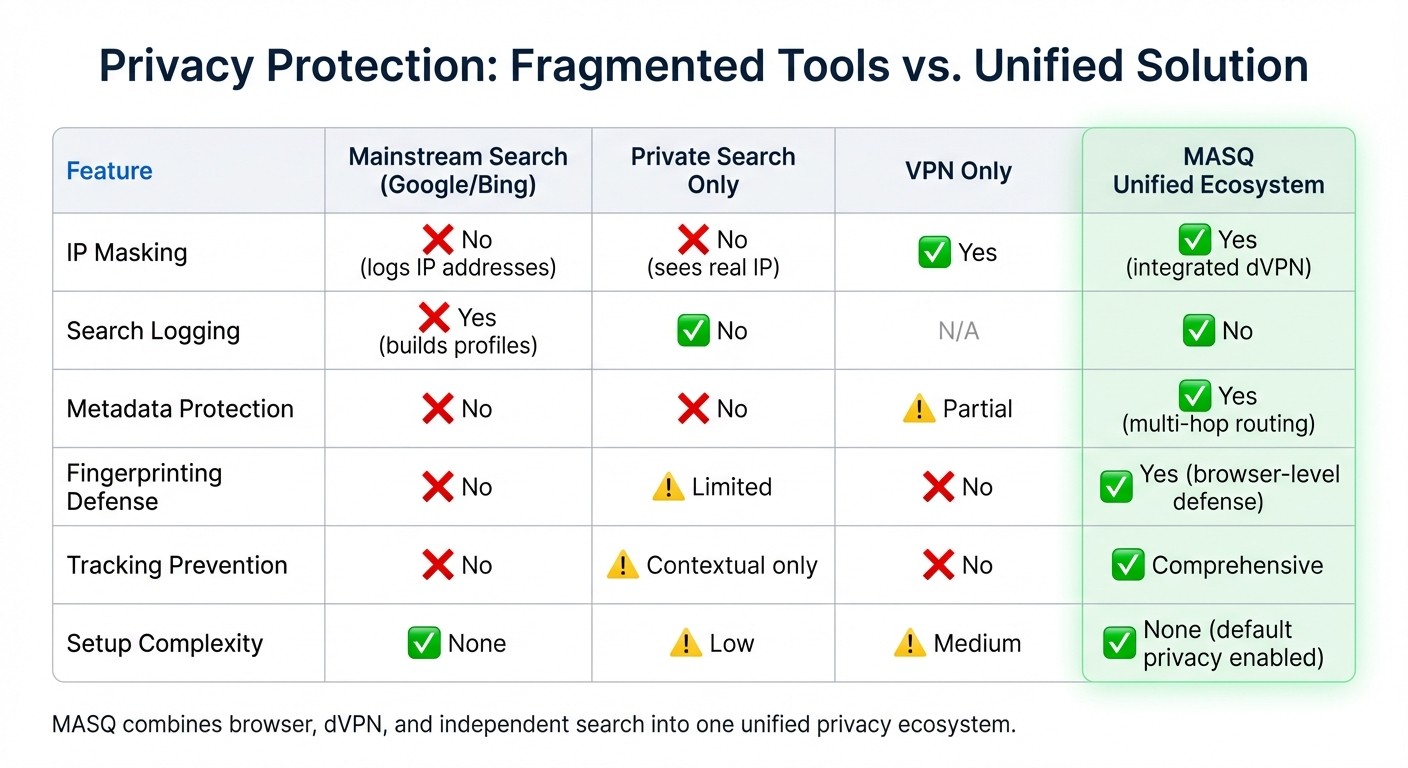
Privacy Features Comparison: Mainstream vs Private Search vs VPN vs MASQ Unified Ecosystem
Many people trying to safeguard their online privacy rely on a mix of individual tools like private search engines, VPNs, and browsers. While these tools each tackle specific privacy concerns, the gaps between them can open up vulnerabilities, leaving your protection incomplete.
Standalone tools - whether it’s a private search engine or a VPN - often fall short when it comes to fully protecting against IP exposure, fingerprinting, and metadata leaks. Even combining multiple tools doesn’t guarantee full anonymity. Metadata, such as connection timing and device fingerprints, can still reveal your identity to network-level observers. As Benjamin Nemeroff from Nym explains:
"It's the difference between clearing your tracks and never leaving any to begin with."
Using isolated tools also requires constant manual adjustments. You have to remember to turn on your VPN before browsing, set your browser’s tracking protection to "Strict", disable WebRTC to avoid IP leaks, and install content blockers like uBlock Origin. Missing just one step can weaken your privacy. Meanwhile, tracking pixels allow dozens of companies to monitor users simultaneously. This piecemeal approach to privacy is in stark contrast to the streamlined, integrated solution offered by the MASQ ecosystem.
Privacy Features Comparison Table
Here’s a breakdown of how fragmented tools stack up against MASQ’s unified privacy system:
Feature | Mainstream Search (Google/Bing) | Private Search Only | VPN Only | MASQ Unified Ecosystem |
|---|---|---|---|---|
IP Masking | No (logs IP addresses) | No (sees real IP) | Yes | Yes (integrated dVPN) |
Search Logging | Yes (builds profiles) | No | N/A | No |
Metadata Protection | No | No | Partial | Yes (multi-hop routing) |
Fingerprinting Defense | No | Limited | No | Yes (browser-level defense) |
Tracking Prevention | No | Contextual only | No | Comprehensive |
Setup Complexity | None | Low | Medium | None (default privacy enabled) |
MASQ addresses these gaps by combining a privacy browser, decentralized VPN, and independent search engine into a single, cohesive platform. Your searches are automatically routed through a peer-to-peer dVPN mesh before reaching Timpi’s independent index, eliminating the need for manual configurations. The MASQ Browser blocks trackers by default, and since there’s no central server, no logs of your activities are stored anywhere. By unifying these privacy tools, MASQ ensures a seamless, secure experience without the vulnerabilities of fragmented solutions.
How to Pick the Right Privacy Search Engine
Choosing a privacy search engine in 2026 means looking beyond just blocking ads or clearing your local browsing history. The reality is that the average internet user is tracked by more than 2,000 companies, and private browsing modes only handle local data - they don’t stop external tracking.
To find the best option, focus on key features like an independent search index (one that doesn’t rely on third-party datasets), a zero-data collection policy (no storage of search queries, IP addresses, or user-agent strings), and anti-fingerprinting measures. Browser fingerprinting, which uses unique system settings to track users, has become even harder to combat than traditional cookie tracking. Additionally, take into account the jurisdiction of the search engine - those based in countries with strong privacy laws offer an extra layer of security. For the most robust protection, look for AI-powered tracker blocking, which can detect and block up to 99.7% of sophisticated trackers in real time.
When to Use MASQ Timpi Search
If total anonymity is your priority, MASQ Timpi Search stands out as a top choice. This search engine automates privacy settings, making it particularly useful for anonymous research, exploring sensitive topics, or bypassing censorship in regions with strict internet controls. Its distributed P2P VPN routing ensures access to unbiased information, free from personalized filter bubbles.
As Gareth Evans, Co-CEO of Timpi, puts it:
"Infrastructure that operates independently of the few chokepoints that currently control the internet."
Timpi’s independent search index, developed over three years, ensures that users aren’t funneled through the algorithms of larger search engines. Available in open beta at timpi.com, it doesn’t require an account to use. Privacy-focused platforms like this can also deliver page load speeds up to 2–3× faster by eliminating the overhead of tracking and ads.
MASQ Premium Features and Benefits
For those seeking an enhanced experience, MASQ Premium offers ad-free searching and advanced privacy features for $8 per month. Payments can be made via credit card or Web3, and no account is needed. Subscribers also gain access to advanced settings and token rewards.
Conclusion
Finding a private search engine in 2026 requires more than just trusting surface-level claims. Many options rely on centralized infrastructure, which inherently limits true independence. Achieving real privacy means embracing a system powered by a community-driven index that removes centralized control points entirely. This approach ensures that every layer of your online activity is protected.
MASQ Timpi Search embodies this vision through a three-year journey to develop a community-powered index. Paired with a decentralized mesh network, it routes searches without centralized logging. Unlike fragmented tools, MASQ combines a browser, VPN, and search into a single, privacy-first solution. The MASQ Browser, decentralized VPN, and Timpi Search work together effortlessly - no setup required, and privacy is built-in by default.
Nicola Considine CPA highlights the significance of this approach:
"The merger of Timpi and MASQ is a bold statement in the world of online privacy. It showcases the potential for innovative companies to offer real alternatives to the status quo".
MASQ takes online privacy to the next level by integrating essential tools into one cohesive system. Whether you're conducting confidential research, navigating around censorship, or simply looking to browse without leaving a trace, MASQ provides a complete solution. The open beta at timpi.com allows users to try it without creating an account. For $8/month, Premium subscribers gain access to ad-free search and enhanced privacy features. Additionally, users can earn $MASQ tokens by running a node and contributing to the network.
The move toward decentralized, user-first infrastructure has already begun. MASQ Timpi Search is paving the way for an internet where control rests with the users - not advertisers.
FAQs
How does MASQ Timpi Search keep my searches anonymous?
MASQ Timpi Search prioritizes your privacy by ensuring that none of your search data is tracked or logged. This means your searches stay completely anonymous, safeguarding your personal information from being collected, sold, or shared with others.
Do I need an account to use Timpi Search or MASQ Premium?
No, you don’t need an account to use Timpi Search or MASQ Premium. Both services are designed to provide full access without requiring any sign-up, making your experience smooth and private.
When should I use 3–5 dVPN hops for searching?
When you want the highest level of privacy and anonymity, using 3–5 dVPN hops is the way to go. Each additional hop makes it harder for trackers or surveillance to trace your IP address or monitor your browsing activity. That said, this setup can slow down your connection speed, so it’s best suited for situations where protecting your privacy matters more than having a fast connection.