
Privacy is deeply influenced by where you live. Different regions view data sharing and protection in unique ways, driven by values like personal independence or group harmony. For example:
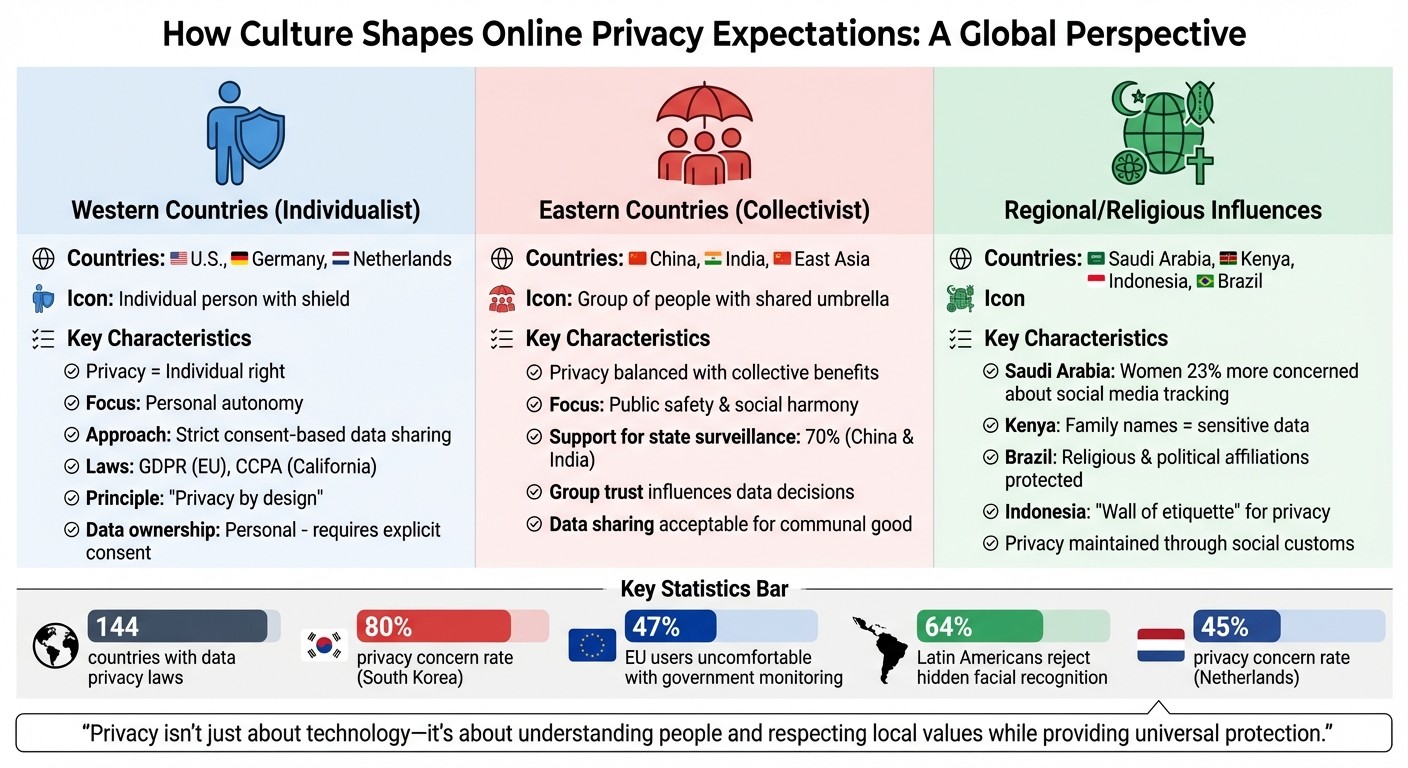
Western countries (e.g., U.S., Germany): Privacy is seen as an individual right. People prefer strict consent-based data sharing and laws like GDPR.
Eastern countries (e.g., China, India): Privacy often takes a backseat to collective benefits, like public safety. Group trust plays a bigger role in data decisions.
Religious and regional norms: In Saudi Arabia, women are more concerned about social media tracking. Kenya protects family details as sensitive data.
These differences create challenges for global privacy tools and laws. A "one-size-fits-all" approach often fails because it ignores these local nuances. For example, WhatsApp faced backlash in India for a privacy update that didn’t consider local values.
Key takeaway: Privacy tools must respect local values while providing universal protection. MASQ, a privacy platform combining a browser, decentralized VPN, and search engine, aims to address this by offering flexible, borderless solutions that align with different expectations.
Privacy isn't just about technology - it's about understanding people.
How Different Cultures View Online Privacy: Global Perspectives Compared
How Different Cultures View Privacy
Individualist Societies and Privacy Prioritization
In countries like the United States, Germany, and the Netherlands, privacy is deeply tied to personal autonomy. It’s seen as a fundamental right, allowing individuals to decide what information they share and with whom. This perspective has driven the creation of strict privacy laws, such as the GDPR in Europe and the CCPA in California. For example, Germans emphasize legal enforcement and "privacy by design" principles, while Americans often lean on opt-in/opt-out systems, even if these options are underutilized.
In these societies, the focus is clear: data is personal, and its collection or sharing requires explicit consent. This highlights the importance of designing privacy solutions like VPNs that align with these expectations. However, not all cultures share this individualistic view of privacy, as seen in more collectivist societies.
Collectivist Cultures and Privacy Trade-offs
In places like China, India, and much of East Asia, privacy is often balanced against communal benefits. Data sharing is generally more acceptable when it contributes to public safety or social harmony. For instance, 70% of people in China and India support state surveillance for national security, compared to only 35% in Japan. This demonstrates how collective well-being can take precedence over individual privacy concerns.
Additionally, collectivist societies tend to differentiate between sharing information within trusted circles versus with strangers. A study found that Indian participants were significantly influenced by the perceived value of their data when deciding to share it, whereas U.S. participants showed less sensitivity to this factor.
Religious and Regional Influences on Privacy Norms
Beyond the divide between individualist and collectivist cultures, local traditions also shape privacy norms. In many societies, privacy is maintained through social customs rather than just digital tools. For example, in Indonesia, Javanese families rely on a "wall of etiquette" to conceal emotional expressions, while Chinese families in Malaysia follow strict rules about sleeping areas to maintain personal boundaries.
In the Middle East, privacy concerns often vary based on gender and age. For instance, in Saudi Arabia, women and older adults are 23% more likely than men to worry about social media tracking. These examples highlight how local traditions and social structures significantly influence privacy perceptions and behaviors. Understanding these nuances is essential for creating privacy solutions that work across diverse cultural contexts.
Challenges of Bridging Global Privacy Norms
Conflicts in Privacy Regulations Across Borders
There are 144 countries with data privacy laws, but the real challenge isn't their sheer number - it’s how differently they interpret privacy. These laws often stem from deeply rooted cultural values. For instance, Kenya considers family names as "sensitive data", Brazil safeguards religious and political affiliations, and New Zealand includes digital behaviors like scrolling speed under its privacy umbrella. On the other hand, the U.S. and EU focus heavily on protecting health-related information, creating a fragmented global landscape.
The EU sees privacy as a fundamental human right, which is why its GDPR imposes strict rules on transferring data outside the European Economic Area unless "adequacy" requirements are met. This creates legal uncertainty for businesses that operate internationally. In contrast, the U.S. opts for a more sector-specific approach, with no overarching federal privacy law, focusing instead on fostering innovation. This often involves choosing between VPNs, Tor, or dMeshVPNs to navigate these varying legal landscapes. Stephanie Forbes, Former IAPP Summer Privacy Fellow, captures this complexity well:
There is no single correct approach to privacy; instead, privacy varies from border to border and is highly dependent on national legal contexts and cultural values.
These differences extend to surveillance policies too. For example, while 70% of citizens in China and India support state monitoring for national security, only 35% of people in Japan agree with such measures. For businesses, this means navigating a maze where what’s legally required in one country might be completely unacceptable - or even illegal - in another. These conflicts highlight how cultural and regulatory differences shape privacy expectations, making global alignment an uphill battle.
Inconsistent Awareness and Education
Regulatory clashes are only part of the story. Uneven awareness and education about privacy rights further complicate things. Even in regions with strong legal frameworks, understanding and adoption vary widely.
Take South Korea, where 80% of consumers are concerned about online privacy. Compare that to the Netherlands, where only 45% express similar concerns. This isn’t just about knowledge - it reflects disparities in infrastructure, enforcement, and trust. In many African nations, privacy laws exist on paper, but limited funding hampers regulators and public education efforts. A law is only as effective as the public's ability to understand and use it. Bridging these gaps will require tailored reforms that respect cultural nuances while addressing resource constraints.
Solutions: Building a Cross-Culture Privacy Framework
Education Campaigns for Privacy Awareness
Privacy education needs to fit the cultural context. What resonates in New York might fall flat in Seoul or São Paulo. For example, in individualistic societies, it’s effective to highlight personal benefits. In regions where uncertainty avoidance is high, focusing on risk reduction works better. Meanwhile, in collectivist cultures, emphasizing institutional transparency and societal benefits can make a stronger impact. Rajiv Sabherwal, a Distinguished Professor at the University of Arkansas, explains:
Firms should, simply put, vary their messaging when targeting users of different cultural experiences... When issuing messages to users in these cultures, designers and developers should emphasize the value that is provided to users.
A good example of what happens when this approach is ignored is the WhatsApp privacy policy update in India in January 2021. WhatsApp announced changes that allowed more data sharing with Facebook, presenting it as a routine clarification. However, India’s collectivist and high uncertainty avoidance culture reacted strongly to the lack of culturally sensitive communication. Millions of users left WhatsApp for alternatives like Signal and Telegram. The takeaway? Communication that aligns with cultural values isn’t just a good idea - it’s critical.
Another important aspect is addressing regional sensitivities around data. For instance, while Western cultures often prioritize health data privacy, Kenya’s Data Protection Act highlights family details - such as children’s and spouses’ names - as sensitive information requiring stricter protection. Similarly, Brazil places special importance on safeguarding religious and political affiliations. Effective education campaigns must acknowledge these distinctions rather than impose a one-size-fits-all definition of privacy. By tailoring education to regional needs, users are better prepared to engage with tools that respect these differences.
Developing Universal Privacy Tools
Universal privacy tools must be flexible enough to adapt to local norms instead of enforcing a rigid global standard. Certifications like ISO 27018 offer a foundation of trust that spans borders. Companies like Amazon, Google, and Dropbox prominently display this certification to showcase their global commitment to cloud privacy. However, even these assurances need to be communicated in ways that align with cultural dimensions like uncertainty avoidance and power distance.
Privacy tools also need to reflect how people make decisions in different cultures. In individualistic societies, users often weigh personal risks and benefits. In collectivist cultures, privacy decisions are shaped by group norms and concerns about "weak ties" (interactions with strangers or acquaintances). A truly universal tool adjusts to these cultural differences rather than forcing everyone into the same mold.
Some regions even have unique privacy requirements. For example, Japan, South Korea, and China mandate that cameras make audible shutter sounds to prevent misuse. Integrating such specific needs into privacy tools helps create solutions that work globally. A good example is MASQ, which combines a privacy browser, decentralized VPN, and independent search engine into a single platform.
MASQ’s peer-to-peer VPN routes traffic worldwide without central logging. This addresses concerns in high uncertainty avoidance cultures (where safety is a priority) and individualistic cultures (where personal control is key). Additionally, its Timpi Search engine - one of the largest search indexes globally - delivers results without hidden algorithms, addressing trust issues common in collectivist societies.
Encouraging Cross-Culture Collaboration
Collaboration among governments, organizations, and communities is essential to develop global privacy standards that respect local values while supporting cross-border data flows. A major challenge is reconciling different views on privacy. For instance, the EU’s rights-focused approach often conflicts with the U.S.’s innovation-driven model, creating legal uncertainty for businesses operating internationally.
In regions like Africa and the Middle East, privacy frameworks should reflect collective values by prioritizing community needs and digital inclusion alongside individual rights. This involves not only enforcing regulations but also funding public outreach and education efforts to close the gap between legal protections and public understanding.
Organizations can also conduct standardized tests to ensure privacy tools are interpreted consistently across cultures. This approach helps avoid missteps like WhatsApp’s experience in India.
Finally, adopting privacy-first technologies that combine universal protections with local flexibility is key. For instance, MASQ’s decentralized network, maintained by hundreds of global nodes, eliminates reliance on corporations and single points of control. Tools designed by communities for communities naturally accommodate diverse cultural needs, avoiding the pitfalls of a top-down, corporate-driven approach. This kind of collaboration lays the groundwork for a privacy framework that balances global requirements with local values.
MASQ: A Privacy Gateway for All Cultures
The MASQ Ecosystem: Privacy Without Borders
Tackling global privacy challenges means creating solutions that work across all cultural landscapes. MASQ has stepped up to the challenge with a privacy ecosystem that knows no borders. In March 2026, MASQ Network joined forces with Timpi to form a unified private internet gateway. This collaboration brought together a privacy browser, a decentralized VPN, and an independent search engine - all in one product. Spearheaded by MASQ Founder Aaron Friedlander and Timpi Co-CEO Gareth Evans, the merger introduced Timpi Search in open beta at timpi.com, seamlessly integrated into the MASQ Browser.
What sets MASQ apart is how it simplifies privacy. Instead of overwhelming users with endless settings or relying on corporate promises, MASQ bundles private browsing, secure connectivity, and independent search into a single, easy-to-use product. As Aaron Friedlander puts it:
Consumers don't adopt infrastructure - they adopt products. This merger lets us package private browsing, independent search, and secure connectivity into one experience that everyday users can actually use.
The foundation of MASQ's system lies in its decentralized infrastructure, which avoids traditional constraints. Its peer-to-peer VPN routes traffic through a global network of community-powered nodes, eliminating centralized logging. Meanwhile, Timpi's search index - ranked among the top five or six globally in depth - operates independently of major platforms. This approach resonates strongly in regions with heightened concerns about surveillance. For instance, 47% of EU users express discomfort with government monitoring, while 64% of Latin Americans reject hidden facial recognition. By merging these technologies, MASQ delivers a seamless, borderless privacy experience tailored to different cultural expectations.
Aligning Privacy Tools with Global Needs
MASQ's design naturally adapts to diverse cultural expectations, thanks to its flexible and robust infrastructure. For individualistic societies like the U.S. and EU - where personal rights and control are central - MASQ ensures autonomy by refraining from collecting browsing data, search history, or connection logs. In contrast, for collectivist cultures in East Asia, where trust and transparency are key, MASQ's community-driven infrastructure and inspectable decentralized network address concerns about corporate accountability.
The platform also addresses varying levels of trust and privacy concerns across regions. In countries like Germany and South Korea, where 80% of users are worried about privacy, MASQ's transparent architecture provides the reassurance they seek. Meanwhile, in regions with weaker privacy protections or heavy state surveillance - such as parts of Africa, the Middle East, China, and India - MASQ's borderless network ensures consistent security, regardless of local regulations.
By uniting these features, MASQ eliminates the hassle of juggling multiple privacy tools with conflicting policies and jurisdictions. Its business model avoids exploiting user data, relying instead on privacy-friendly search advertising, enterprise API services, and user subscriptions. Gareth Evans sums it up perfectly:
Today's internet is controlled by a few actors. We are creating a new, transparent, and decentralized infrastructure in the hands of the community.
Digital Personas vs. Real Life | An Anthropologist Explains
Conclusion
Privacy is deeply influenced by cultural norms - it’s not a one-size-fits-all concept. Around the world, cultural values shape how people perceive data protection. In Western countries, for example, privacy often focuses on individual rights, while regions like Africa and the Middle East may prioritize community well-being over strict personal controls. These differences create real challenges: some areas emphasize personal autonomy, while others balance privacy with goals like public safety or social harmony. Addressing these varied perspectives requires solutions that respect these cultural nuances.
What’s needed are practical tools that work across these differences. Organizations can’t rely on universal designs alone; instead, they must create systems that align with local values while still delivering consistent protection. This means considering cultural factors like how much uncertainty people are comfortable with or how authority is perceived, and then building adaptable infrastructures that don’t compromise security.
MASQ’s integrated ecosystem offers one example of this in action. By combining a privacy browser, peer-to-peer VPN, and independent search engine into a single platform, MASQ removes the need for users to navigate inconsistent policies or rely on centralized entities. Whether someone lives in a region with strict privacy laws or heavy surveillance, MASQ ensures the same level of protection through its decentralized, community-driven design.
Moving forward, collaboration between individuals, organizations, and governments is essential to create frameworks that respect cultural diversity while safeguarding universal privacy rights. As digital resignation grows - where many users feel data breaches are unavoidable - the demand for trustworthy, easy-to-use privacy tools becomes even more urgent. This collective effort shows that privacy without borders isn’t just an idea - it’s already becoming a reality.
FAQs
Why do privacy expectations differ so much by culture?
Privacy expectations differ widely across the globe, shaped by varying values and social norms. In individualistic societies, such as the United States, there’s a strong focus on personal control over one’s data. On the other hand, in more collectivist cultures, the emphasis often shifts toward maintaining group harmony and fostering trust within the community. These cultural distinctions don’t just influence personal attitudes - they also shape legal systems and approaches to data sharing and surveillance. Recognizing and respecting these differences is essential for designing privacy solutions that honor diverse viewpoints and help close gaps in global privacy awareness.
How can privacy tools adapt to local norms without weakening protection?
Privacy tools can align with societal norms by acknowledging varying privacy expectations between collectivist and individualist cultures. To achieve this, they can incorporate features like customizable privacy settings, locally relevant explanations, and clear data usage practices. These elements allow users to tailor their data management to reflect their community's values. At the same time, maintaining safeguards like data minimization and robust security helps build trust and ensures compliance with diverse user needs.
What can organizations do to raise privacy awareness across regions?
Organizations can boost privacy awareness by recognizing and addressing differences in how privacy is perceived across various regions. For example, in individualistic societies like the U.S., there’s a strong emphasis on personal autonomy. On the other hand, collectivist societies often focus more on maintaining group harmony. To bridge these perspectives, it’s important to create campaigns and policies that resonate with these distinct values. Additionally, leveraging privacy-first tools such as MASQ can help highlight privacy as a universal right, encouraging a shared sense of awareness and trust worldwide.