
95% of global search traffic flows through a single company - Google. This dominance isn't just about convenience; it raises serious concerns about manipulation, censorship, and privacy. Most search engines depend on centralized indexes, inheriting their biases and limitations. Only four companies - Google, Bing, Yandex, and Baidu - currently maintain independent web indexes.
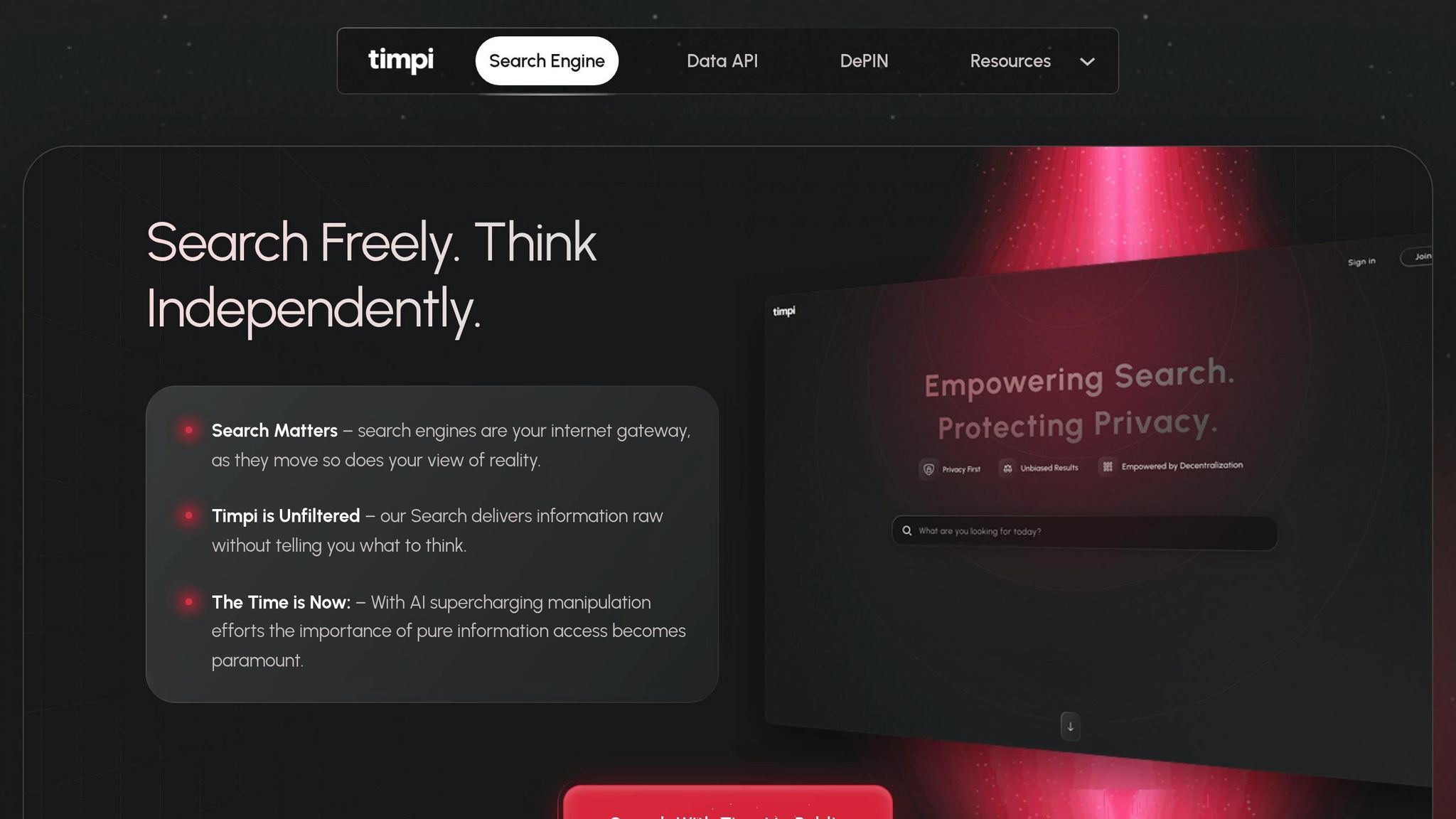
In March 2026, Timpi and MASQ Network announced they were jointly merging product ecosystems and supported the launch of Timpi Search, a decentralized, privacy-first search engine. Unlike others, it builds its own web index and operates on a community-managed node network, ensuring no single entity controls the flow of information. With no tracking or data exploitation, Timpi Search offers users a secure, independent alternative to Big Tech.
Key takeaways:
Centralized search engines control the majority of online information.
They manipulate results, censor content, and exploit user data.
Timpi Search is independent, decentralized, and privacy-focused.
Users can access Timpi Search without creating an account.
The choice is clear: centralized control or independent freedom. Timpi Search stands as a new option for those seeking control over their digital lives.
Timpi - The World's 1st Decentralized Privacy Search Engine
Problems with Centralized Search Engines
When a single company controls 92% of the world's internet searches, the consequences go far beyond simple market dominance. Platforms like Google shape the information billions of people encounter - and just as importantly, what they don’t. This level of control leads to three main challenges: manipulation of search results, censorship, and privacy concerns.
Search Results Manipulation and Information Bias
Centralized search engines don’t just retrieve information; they decide what’s most visible. Google, for instance, acts as what data researcher Prithwish Nath calls an "institutional gatekeeper." For topics like health and finance, institutional sources (.gov, .edu, and .org domains) dominate the top three search positions, making up 73.33% of those results, while commercial .com sites account for only 16.67%.
This institutional bias has real-world implications. Nath explains:
Reality, according to Google, is what institutions say it is.
While institutions often provide reliable information, they’re not infallible. For example, medical authorities classified transgender identity as a psychiatric disorder until 2019. During that time, Google’s algorithms may have buried dissenting views that ultimately contributed to this reclassification.
Other search engines aren’t immune to bias, either. Bing, for example, frequently relies on pre-selected sources, creating what Nath calls an "epistemic monoculture." A staggering 43.82% of Bing’s technical search results come from just one source: StackOverflow. This heavy reliance on a single source means the accuracy of results is only as good as that source.
Adding to the problem, search engine results are highly fragmented. Only 2-3% of domains appear across all four major engines (Google, Bing, DuckDuckGo, and Yandex) for the same query. Even Google’s results overlap with competitors’ top 10 listings by just 24% to 25%. According to information scientist Jutta Haider, many search engines also exhibit:
a strong consumerist bias,
often prioritizing links to shopping or commercial sites over more diverse or informative content. This manipulation not only limits access to balanced information but also undermines the idea of digital independence.
Censorship and Restricted Information Access
Censorship on centralized platforms often takes subtle forms. Instead of outright bans, alternative viewpoints are pushed so far down in rankings that they’re effectively invisible.
This reliance on a few dominant indexes creates a single point of failure for accessing information. When Google or Bing excludes specific websites or flags content without clear explanations, their decisions affect not just their users but also those relying on engines that pull from their indexes. Nath describes this as a system that:
collapses disagreement into consensus and emergent knowledge into settled fact.
By suppressing alternative perspectives, these platforms make it harder for users to verify claims or explore diverse viewpoints, ultimately narrowing the scope of public discourse.
Privacy Issues and Data Exploitation
Every search query feeds into a massive data collection system. Centralized engines track your searches, clicks, and online behavior, building detailed user profiles for targeted advertising.
But the data collection doesn’t stop there. These platforms integrate search data with other services, creating a comprehensive profile tied to your identity. Jutta Haider highlights this feedback loop:
Web search engines improve when they are used. The developers get feedback on what people are searching for, how the searches are going, what is being clicked on, and so on.
While this process helps refine search results, it also reinforces the dominance of these platforms. With every query, users unknowingly contribute to the data monopolies that power these engines. This data collection isn’t just a privacy concern - it creates vulnerabilities. Tools capable of unmasking supposedly anonymous accounts are available for as little as $4, turning user behavior into a commodity and exposing individuals to potential surveillance or exploitation.
How Independent Search Protects Internet Freedom
Independent search engines offer an alternative, transparent way to access information. Unlike centralized platforms that shape what billions see, these engines operate on their own infrastructure. This approach tackles issues like manipulated search results, censorship, and privacy concerns - problems often linked to centralized systems.
Unbiased Results Through Transparent Algorithms
One major distinction lies in how independent search engines index the web. Unlike aggregators that rely on results from providers like Google or Bing, independent engines build their own indexes. This method avoids inheriting the biases, commercial interests, and privacy compromises of centralized platforms.
Timpi stands out by incorporating community-led governance and their decentralized indexing and retrieval layers. This system allows the community to influence ranking logic and content standards, ensuring fair results and supporting digital sovereignty - key to maintaining an open information ecosystem.
Decentralized Infrastructure to Combat Censorship
Centralized search engines often create control points where information can be restricted or manipulated. Timpi addresses this by using a decentralized network of nodes to power its web index. This eliminates single points of failure, ensuring no central authority can suppress or exclude information.
Gareth Evans explains this vision:
The internet today runs through a handful of chokepoints. We're building the infrastructure that sits outside that - inspectable, decentralised, and owned by its community.
The Timpi Autonomous Protocol (TAP) coordinates web crawling and indexing across this global network. This decentralized system not only prevents censorship but also empowers users to take back control of their online experiences.
Privacy-First Search Without Data Exploitation
Independent search engines also prioritize user privacy, steering clear of the data exploitation seen in centralized models. Instead of treating users as products, they generate revenue through search ads, enterprise API services, and subscriptions - avoiding behavioral profiling or data monetization. No tracking, logging, or targeted advertising is involved.
Timpi’s decentralized infrastructure further strengthens privacy. With data spread across a network rather than centralized servers, there’s no single database vulnerable to misuse. As of March 2026, users can access Timpi Search in open beta without creating accounts or being subjected to surveillance.
MASQ Founder Aaron Friedlander highlights the user benefits:
This merger lets us package private browsing, independent search, and secure connectivity into one experience that everyday users can actually use.
Timpi Search: An Integrated Solution
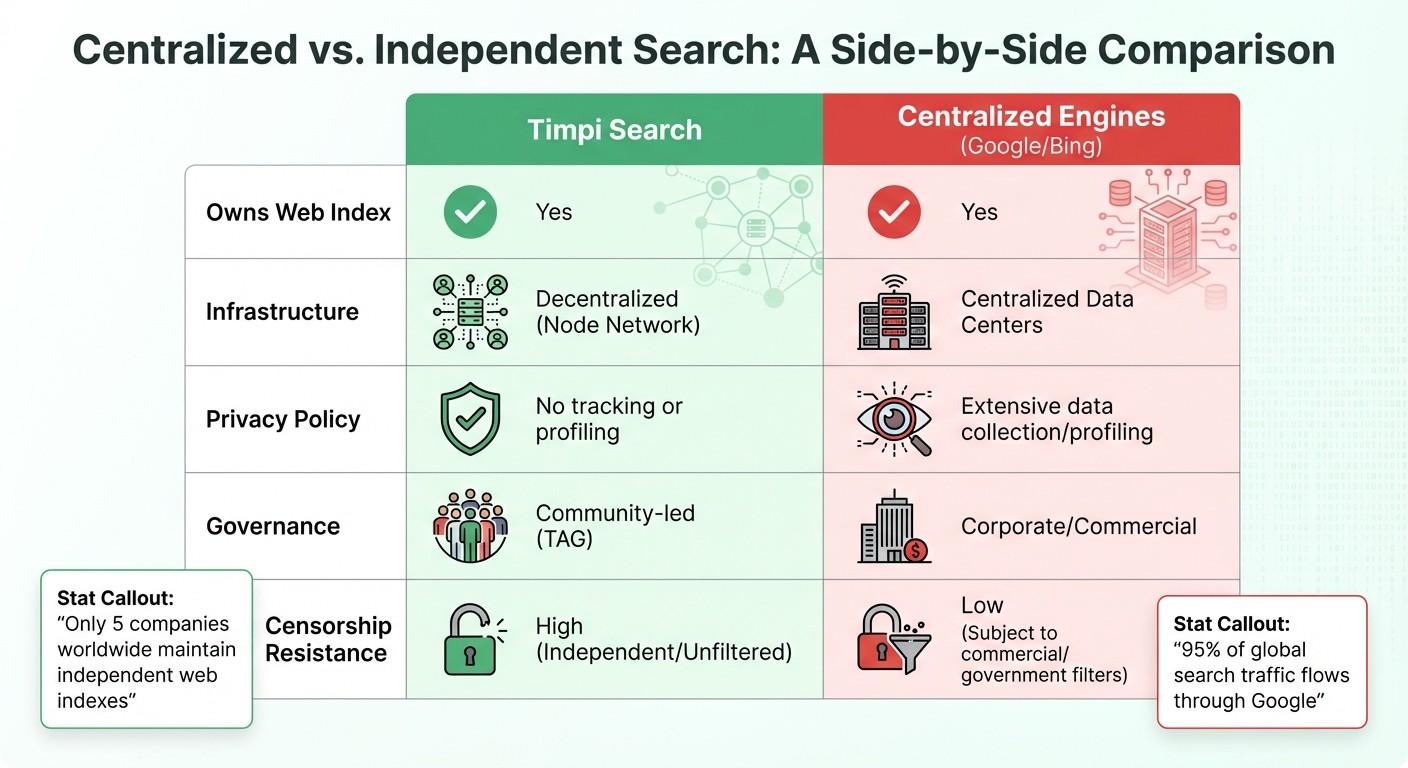
Centralized vs Independent Search Engines: Key Differences
Timpi Search offers a practical solution to the challenges posed by centralized search engines. Unlike platforms that act as privacy layers over existing data, Timpi is built from the ground up as an independent search engine. It joins the ranks of Google, Bing, Yandex, and Baidu as the world's fifth large-scale independent search engine.
Key Features of Timpi Search
Timpi Search operates through a decentralized network of community-managed nodes - Collector, Guardian, and GeoCore - coordinated by the Timpi Autonomous Protocol (TAP). This eliminates the need for corporate data centers entirely.
Privacy is at the heart of Timpi's design. It does not track, profile, or collect user data. Instead, revenue is generated through search advertising, enterprise API services, and subscriptions. Users can access Timpi Search in open beta at timpi.com without creating an account.
The Timpi Autonomous Government (TAG) gives users a say in how the platform operates. This community-driven system allows people to influence ranking algorithms and content standards. Additionally, users and node operators can earn $TIMPI tokens for their contributions, whether by helping expand the index or reviewing content.
These features set Timpi apart from traditional, centralized search engines. The following table highlights the differences.
Comparison: Centralized Search vs. Timpi Search
Feature | Timpi Search | Centralized Engines (Google/Bing) |
|---|---|---|
Owns Web Index | Yes | Yes |
Infrastructure | Decentralized (Node Network) | Centralized Data Centers |
Privacy Policy | No tracking or profiling | Extensive data collection/profiling |
Governance | Community-led (TAG) | Corporate/Commercial |
Censorship Resistance | High (Independent/Unfiltered) | Low (Subject to commercial/government filters) |
Integration with the MASQ Ecosystem
Timpi Search takes its features a step further by integrating with the MASQ ecosystem, creating a unified, privacy-first platform. On March 25, 2026, Timpi merged product ecosystems with the MASQ Network, combining their technologies and having the MASQ brand become the consumer arm joint privacy-led products like MASQ Browser and Timpi Search.
This integration brings together private browsing, independent search, and secure connectivity in one seamless experience. Timpi Search is built into the MASQ Browser, which also features a distributed VPN (dVPN) that routes user connections through a decentralized network. This ensures private web searches without tracking, ad profiling, or centralized data collection.
By combining independent search with decentralized infrastructure, this ecosystem combats centralized control and strengthens digital sovereignty. It empowers communities while addressing issues like censorship and data exploitation that plague centralized platforms, all while preserving a free and open internet.
The ecosystem generates revenue through search advertising, enterprise data services, and MASQ consumer subscriptions, completely avoiding the exploitative data collection model.
Conclusion
A truly free internet means breaking away from centralized control. When 90% of global search traffic is funneled through a single company, it limits access to information and creates an imbalance of power. Centralized search engines not only manipulate search results but also exploit user data to generate a staggering $224 billion annually in advertising revenue. These platforms often filter information based on commercial or political interests, restricting what users can see.
Timpi Search addresses these challenges by standing as one of only five companies worldwide with a large-scale independent web index, operating outside the influence of Big Tech. Its decentralized node network, governed by the community through TAG, and its privacy-first approach eliminate the need for corporate data centers, opaque algorithms, and intrusive tracking. The merger with MASQ Network in March 2026 further enhanced this vision by creating a comprehensive privacy ecosystem. This ecosystem combines independent search, private browsing, and decentralized connectivity into a unified experience.
"The internet today runs through a handful of chokepoints. We're building the infrastructure that sits outside that - inspectable, decentralised, and owned by its community." - Gareth Evans, Co-CEO, Timpi
This mission is all about protecting digital sovereignty. Independent search not only ensures privacy but also keeps the internet open and accessible for everyone. The MASQ ecosystem demonstrates that users no longer have to choose between convenience and freedom. Timpi Search, available in open beta at timpi.com, offers this solution without requiring an account.
At its core, every advancement here serves one goal: digital freedom. The choice is clear - continue feeding data to centralized platforms or reclaim your online independence. Independent search paves the way for a free and open internet.
FAQs
What makes a search engine “independent”?
Independent search engines build and maintain their own web indexes, steering clear of reliance on Big Tech frameworks. This approach promotes decentralization, delivers unbiased search results, and prioritizes stronger user privacy safeguards. By staying independent of centralized systems, these platforms give users the freedom to explore information without the shadow of constant surveillance.
How does decentralization reduce censorship risk?
Decentralization helps lower the risk of censorship by removing the need to depend on centralized authorities. Without a single controlling entity, it becomes much more difficult for anyone to suppress or manipulate information. Independent search engines, for example, create their own web indexes outside the control of major tech companies. This limits the power of centralized platforms and promotes broader access to information that is less likely to be biased.
How does Timpi Search stay private without tracking?
Timpi Search prioritizes your privacy by not collecting or storing any user data. It doesn’t engage in profiling or monitoring, ensuring that all your searches remain completely private and anonymous.