
Living under constant digital surveillance is harming mental health. From anxiety to stress, the effects are real and widespread. Here’s what you need to know:
Surveillance triggers stress: Feeling watched activates a fight-or-flight response, draining mental energy and causing anxiety.
Privacy is a core need: Without it, people struggle to maintain boundaries, process emotions, and feel secure.
AI worsens privacy concerns: Algorithms can re-identify 99.98% of anonymized data, leading to discomfort and behavioral changes.
Data breaches amplify harm: Sudden privacy violations create distress and erode trust in online systems.
Anonymity helps: Tools like decentralized VPNs and privacy-focused browsers reduce stress by protecting personal data.
The solution? Use privacy tools that safeguard your online activity and reclaim control over your digital life. Protecting privacy isn’t just about data - it’s about mental well-being.
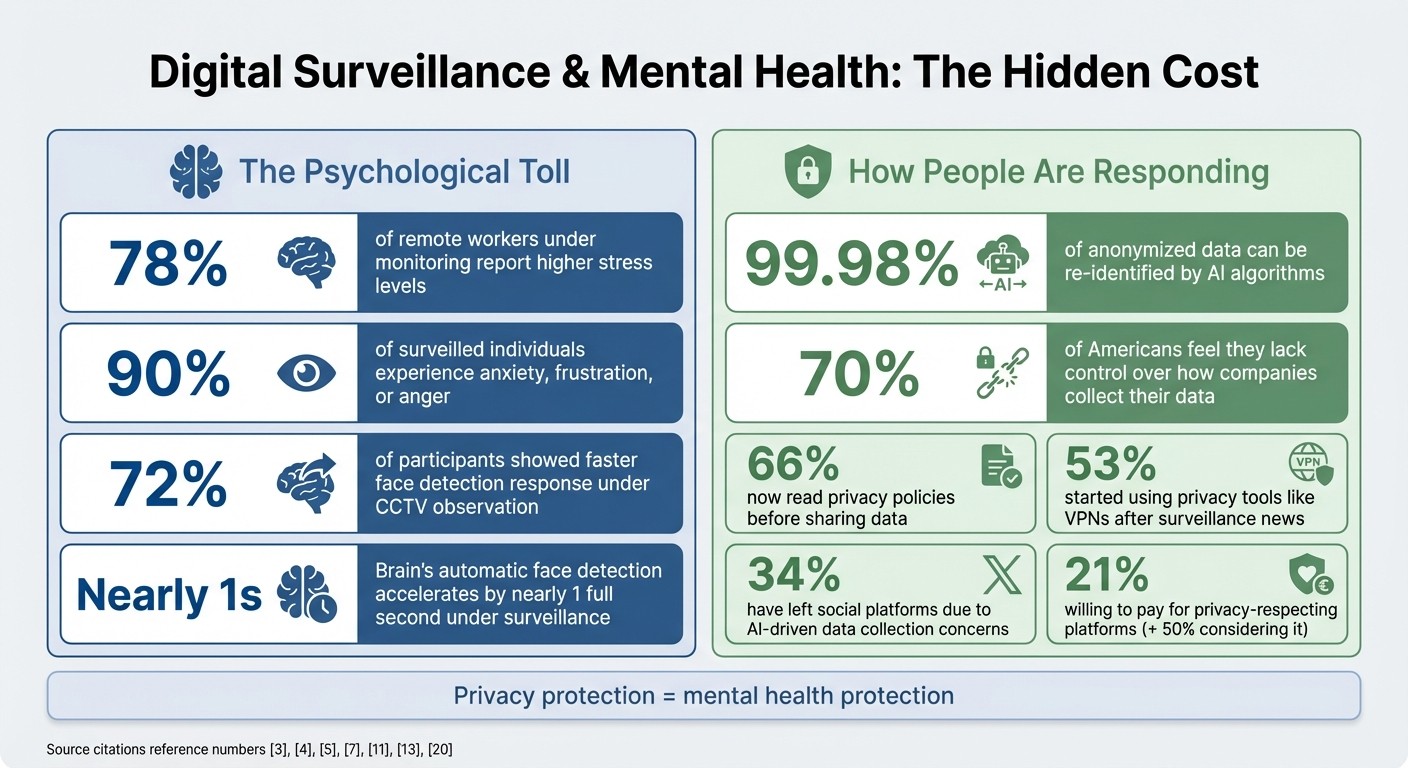
How Digital Surveillance Impacts Mental Health: Key Statistics
Digital Surveillance Resources Series 1: Understanding Digital Surveillance
How Surveillance Affects Mental Health
Digital surveillance does more than infringe on privacy - it reshapes how our brains function, often leading to observable psychological harm. These effects include persistent stress and altered cognitive processes.
The Mental Cost of Being Watched Online
Knowing you're under constant watch activates your brain's survival instincts, pushing it into overdrive. This triggers the fight-or-flight response, which drains mental energy. Neuroscientist Kiley Seymour from the University of Technology Sydney explains:
"The conclusion would be that being watched drives this hardwired survival mechanism into overdrive... You're in fight-or-flight mode, which is taxing on the brain."
Studies reveal that surveillance accelerates the brain's automatic face detection response by nearly a full second. For example, in one experiment, 72% of participants identified direct-gazing faces much faster when they knew CCTV cameras were observing them.
Unlike stress from a single event, digital surveillance is constant and unavoidable. Everyday devices like smart speakers, fitness trackers, and connected cars seamlessly embed this monitoring into daily life. The result? Mental fatigue, reduced working memory, and physical symptoms such as tension headaches and disrupted sleep patterns. These effects show up in emotional (persistent anxiety), cognitive (mental exhaustion), and behavioral (self-censorship) forms.
Prolonged exposure to surveillance can also heighten sensitivity to social cues, a response similar to what’s seen in conditions like psychosis and social anxiety disorder.
For marginalized groups - such as people of color, LGBTQ+ individuals, and activists - the stakes are even higher. Surveillance can lead to severe consequences like deportation, job termination, or police scrutiny, amplifying psychological stress. This is particularly evident during internet freedom crises where state-level monitoring intensifies.
These chronic stressors also make individuals more vulnerable to intense reactions when their privacy is abruptly violated, such as during data breaches.
The Psychological Impact of Data Breaches
The constant pressure of surveillance is compounded by the shock of unexpected data breaches. When personal information is exposed, it disrupts any sense of security. Experts call this "privacy turbulence" - a sudden and unpredictable threat that’s more distressing than gradual privacy loss because the body cannot prepare for it.
This kind of intrusion can cause severe mental anguish. Some researchers argue that long-term exposure to surveillance, combined with recurring privacy violations, could lead to a new form of PTSD. Unlike trauma from a single event, this stems from ongoing, low-level stress. A psychologist describes this phenomenon as follows:
"Digital paranoia represents a unique collision between legitimate privacy concerns and psychological distress in an era where the boundaries between reasonable vigilance and pathological anxiety have become frustratingly blurred."
Responses to these threats vary. Some people adopt healthy skepticism, like using encrypted messaging apps or a VPN, while others spiral into extreme paranoia - avoiding technology altogether or believing devices are reading their thoughts. The key difference lies in whether the response is grounded in evidence or disrupts daily life.
The mental health toll of living under constant surveillance is undeniable. As the NeuroLaunch editorial team cautions:
"The long-term emotional impact of living under constant surveillance is a ticking time bomb of mental health issues."
How Anonymity Protects Mental Health
Constant surveillance can weigh heavily on the mind, but anonymity offers a much-needed reprieve. Being able to browse, search, and connect without revealing your identity creates a safe space, especially when seeking mental health support.
Anonymous Access to Mental Health Resources
Anonymity encourages people to open up by removing the pressure to maintain a polished image. This phenomenon, known as benign disinhibition, allows individuals to discuss their struggles more freely, whether it’s about symptoms, medications, or personal experiences. Without the fear of judgment, these conversations become more honest and helpful.
However, many mental health apps fail to protect user privacy, which highlights the importance of anonymity. Without it, people often self-censor, avoiding searches related to depression, anxiety, or trauma out of fear that their data could later impact their careers, insurance, or personal relationships. For LGBTQ+ individuals in unsupportive environments or anyone exploring deeply personal topics, anonymity isn’t just helpful - it’s essential.
To maintain this privacy, robust tools are necessary.
Privacy Tools That Enable Anonymity
Achieving true anonymity takes more than just good intentions; it requires reliable technical solutions. Standard private browsing modes fall short, as research shows AI can re-identify nearly 99.98% of anonymized data.
MASQ steps in with a decentralized VPN network and privacy browser designed to keep your activities private. Unlike centralized services that log your data, MASQ uses a peer-to-peer network with no central authority and no activity logging. This ensures that your searches, visits to support forums, or therapy app usage remain confidential. Additionally, its integrated Timpi Search engine provides results without building a profile of your queries - an essential feature for exploring sensitive topics.
"Privacy is a fundamental psychological need: It allows us to recover from harm and develop an individual identity."
Elias Aboujaoude, MD, Professor of Psychiatry and Behavioral Sciences at Stanford University
Privacy tools like these empower individuals by giving them back control over their data. A recent study found that over 70% of Americans feel they lack control over how companies collect their personal information. Decentralized solutions, such as MASQ, help restore that control, ensuring your mental health journey remains private. By protecting your identity, anonymity not only shields your privacy but also alleviates the mental burden of living under constant surveillance.
How Privacy Concerns Lead to Better Solutions
The mental strain of constant surveillance is pushing many to take action. As people become more aware of the extent of tracking in their daily lives, their minds respond with a heightened sense of vigilance. This ongoing stress doesn’t just create discomfort - it sparks a desire for change and solutions.
Changing Attitudes About Digital Privacy
Recent research highlights a shift in how Americans approach digital privacy. For example:
53% started using privacy tools like VPNs after news of foreign surveillance.
66% now read privacy policies before sharing their data.
34% have left social platforms due to concerns about AI-driven data collection.
21% are willing to pay for platforms that respect their privacy, with another 50% considering it.
These changes reflect a logical reaction to real risks. Rather than passively accepting self-censorship as a norm, people are actively seeking tools that let them browse and communicate freely without fear of being monitored.
This growing awareness is paving the way for decentralized solutions that don’t rely on centralized authorities.
How Decentralized Technologies Help
As privacy concerns grow, decentralized tools are stepping in to provide robust protections that centralized systems simply can’t match. The issue with traditional privacy solutions is their dependence on a central authority - one that users must trust not to misuse their data. Decentralized technologies remove this risk by eliminating that single point of failure.
Take MASQ as an example. It combines a decentralized VPN network, a privacy-focused browser, and an independent search engine, all built on a peer-to-peer infrastructure. This setup ensures there’s no central logging or oversight.
Unlike centralized services that often collect metadata despite promises of privacy, MASQ routes traffic through a global network of community-maintained nodes. There’s no central server or database to compromise your data. Its integrated Timpi Search engine delivers search results without profiling your queries, breaking the cycle of tracking algorithms that can push harmful or manipulative content.
For the 70% of Americans who feel they lack control over how companies use their data, decentralized solutions offer more than just assurances - they provide structural safeguards. Without a central authority to gather your data, there’s nothing to sell, leak, or exploit. This isn’t just about technical security; it’s about the peace of mind that comes with knowing your searches, online activities, and personal interests remain private.
Conclusion: Protecting Privacy to Improve Mental Health
Studies reveal a strong connection between digital surveillance and mental health challenges. For example, 78% of remote workers under monitoring report higher stress levels, while 90% of surveilled individuals experience feelings like anxiety, frustration, or anger.
A lack of privacy forces people into constant performance mode, leading to self-censorship and heightened vigilance. These conditions drain mental energy and suppress genuine self-expression. Privacy, on the other hand, provides the space to heal, reflect, and build a personal identity. Unfortunately, centralized platforms often compromise this critical need.
Privacy-focused tools offer a way to regain this psychological safety. MASQ's decentralized system - featuring a privacy browser, VPN network, and the independent Timpi Search engine - removes the reliance on central authorities to oversee your online activities. Without search logs or profiling, these tools empower users to retain digital autonomy. By prioritizing anonymity, they not only secure your data but also reduce the mental strain caused by constant surveillance.
Taking back control of your digital privacy is an act of self-care. When you browse and communicate free from tracking, you protect more than just your data - you safeguard your freedom to think, explore, and maintain healthy mental boundaries.
Your mental health deserves protection. Choose tools that honor your privacy.
FAQs
How can I tell if online surveillance is affecting my mental health?
Signs that online surveillance may be impacting mental health include feelings of anxiety, paranoia, or unease about being tracked. For many, the realization of constant monitoring or seeing overly personalized ads can be a source of discomfort. Studies have shown that being aware of surveillance can lead to behavioral shifts and heightened anxiety.
Some common symptoms to watch for include hypervigilance - always feeling on edge - and compulsive behaviors, like repeatedly checking privacy settings. Recognizing these signs is the first step toward addressing the issue.
Using tools designed to protect your privacy, like MASQ, a decentralized privacy browser, can help reduce surveillance. This kind of proactive measure not only gives you greater control over your online presence but may also help alleviate some of the stress tied to digital tracking.
What are the best daily habits to reduce digital privacy stress?
To ease the stress tied to digital privacy, try building these habits into your daily routine:
Update your privacy settings: Regularly check and adjust the privacy settings on your apps and accounts to ensure you're sharing only what you intend to.
Strengthen your defenses: Use strong, unique passwords and enable multi-factor authentication wherever possible for an added layer of security.
Keep devices up to date: Install updates promptly to protect against vulnerabilities.
Additionally, consider using privacy-focused tools. Encrypted messaging apps and VPNs (especially decentralized ones) can help reduce tracking and safeguard your data. Be mindful of how much you share online, and make privacy awareness part of your everyday mindset. These small, consistent actions can help reduce the mental toll of constant surveillance.
How does MASQ help me stay anonymous online?
MASQ helps safeguard your online privacy through a decentralized VPN and a Web3 privacy browser. It works by concealing your IP address, limiting browser fingerprinting, and blocking tracking mechanisms. These tools collectively shield your digital activity and lower the chances of being monitored.