
Netflix restricts content by region using geo-blocking, but many users turn to VPNs to bypass these limits. While VPNs are legal in most countries, using them to access Netflix libraries violates the platform’s Terms of Service. Here’s what you need to know:
Geo-blocking: Netflix licenses content regionally, meaning shows available in one country might not be in another.
How VPNs work: VPNs mask your IP address, tricking Netflix into thinking you're in a different location.
Legal risks: Using VPNs for Netflix is not a crime in the U.S., UK, or Canada, but it breaches Netflix’s rules, potentially leading to account suspension.
Detection: Netflix uses advanced methods to block VPN traffic, including IP databases and behavior analysis.
Decentralized VPNs (dVPNs): Options like MASQ use residential IPs, making detection harder.
While Netflix enforces its policies through technical blocking rather than legal action, understanding the risks and choosing privacy-focused tools like dVPNs can help minimize issues.
Is It Legal to Use a VPN For Netflix?

Legal Risks of Using VPNs for Netflix
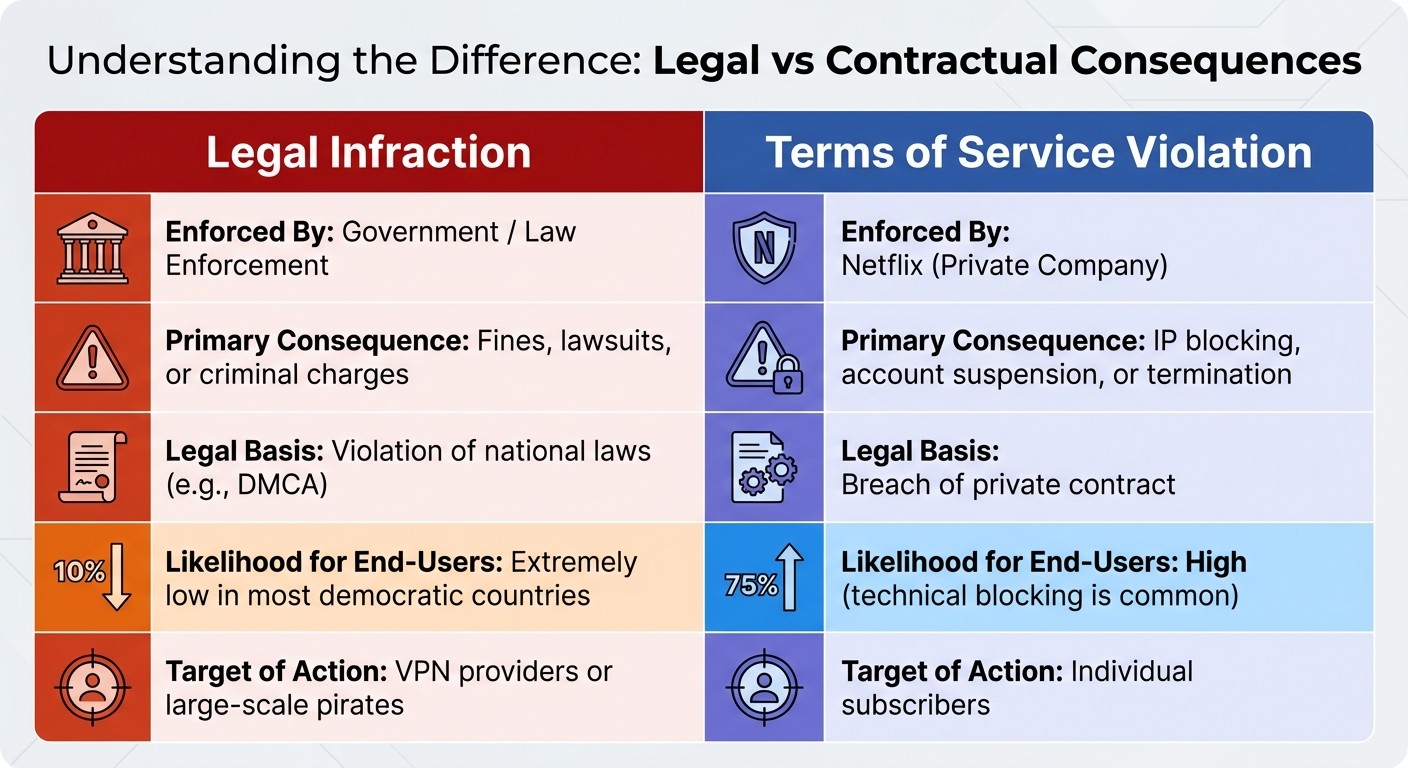
Legal Infraction vs Terms of Service Violation: Netflix VPN Usage Comparison
Are VPNs Legal?
VPNs are legal in the U.S. and most Western countries, primarily for privacy and security purposes. However, in countries like China, Russia, Iran, Turkey, North Korea, Belarus, Iraq, Turkmenistan, and the UAE, VPN use is either banned or tightly controlled. If you're traveling to these regions, using a VPN could lead to fines or even criminal charges from local authorities.
That said, while the use of VPNs is lawful in many places, employing them to bypass Netflix's restrictions can lead to contractual issues.
Netflix Terms of Service Violations
Even though VPNs are legal in the U.S., using one to get around Netflix's geo-blocking violates the platform's Terms of Service. According to Section 4.3, Netflix content should be accessed "primarily within the country in which you have established your account". Section 4.6 goes further, explicitly prohibiting users from bypassing content protections:
"You also agree not to circumvent, remove, alter, deactivate, degrade or thwart any of the content protections in the Netflix service... We may terminate or restrict your use of our service if you violate these Terms of Use."
When Netflix detects a VPN, it typically displays a "proxy error" message and blocks access until the VPN is disconnected. While Netflix has the authority to suspend or terminate accounts for such violations, there are no widespread reports of users being banned solely for using a VPN. Instead, Netflix focuses on blocking VPN server IP addresses rather than targeting individual users.
Legal Infractions vs. Terms of Service Violations
It's important to distinguish between legal consequences and contractual breaches. Using a VPN to access Netflix content from another region violates Netflix's Terms of Service but isn't considered a criminal act in the U.S. Dr. Lena Müller of Humboldt University explains:
"Geo-blocking is a commercial licensing mechanism, not a legal boundary enforced by criminal code. A German citizen watching U.S. Netflix via a VPN while on vacation in Thailand violates no German, Thai, or U.S. criminal law. What they may breach is Netflix's Terms of Use - a civil, contractual matter, not a statutory one."
In the U.S., the Digital Millennium Copyright Act (DMCA) primarily targets those who create or distribute tools to bypass restrictions, rather than individual users who use those tools to access content they've already paid for. Legal action typically focuses on VPN providers or large-scale piracy operations, not everyday subscribers.
Feature | Legal Infraction | Terms of Service Violation |
|---|---|---|
Enforced By | Government / Law Enforcement | Netflix (Private Company) |
Primary Consequence | Fines, lawsuits, or criminal charges | IP blocking, account suspension, or termination |
Legal Basis | Violation of national laws (e.g., DMCA) | Breach of private contract |
Likelihood for End-Users | Extremely low in most democratic countries | High (technical blocking is common) |
Target of Action | VPN providers or large-scale pirates | Individual subscribers |
How Netflix Detects and Blocks VPNs
VPN Detection Techniques
Netflix uses a mix of advanced technologies to identify and block VPN traffic. One key method involves maintaining extensive IP databases that include addresses from VPN providers, data centers, and cloud services. If your IP matches one of these entries, Netflix immediately blocks access, displaying the dreaded "Proxy detected" error (M7111-1331-5059).
Another approach is analyzing shared IP usage. When excessive traffic originates from a single IP - common with VPN-assigned addresses - it's flagged as suspicious. Netflix also employs Deep Packet Inspection (DPI), which examines VPN protocol fingerprints like packet headers, sizes, and timing patterns to detect encrypted traffic. Additionally, the platform looks for mismatched DNS and IP data, such as when your IP suggests one country but your DNS queries point to another.
Behavioral heuristics play a role as well. For example, if an account logs in from Tokyo and then rapidly switches to a UK server, Netflix flags this as unusual region-hopping, often linked to VPN use. These combined detection methods give Netflix a high accuracy rate for identifying commercial VPN exit nodes - reportedly over 99.7%.
Beyond technical methods, Netflix also keeps an eye on user behavior to enforce its policies.
Account Sharing and Household Verification
Netflix adds another layer of enforcement with household verification, aimed at reducing unauthorized access. This involves analyzing device fingerprints and consistent IP usage patterns to confirm that account activity stays within a single household. However, this system isn't perfect. Around 58% of account lockouts are due to geolocation mismatches caused by ISP routing issues rather than actual VPN use.
When Netflix detects suspicious activity, it often imposes soft locks. These temporarily block playback but allow users to verify their identity and regain access. Interestingly, Netflix rarely terminates accounts solely for VPN use. Instead, the focus is on blocking the infrastructure enabling it. As former Netflix CEO Reed Hastings once stated:
"It's a very small but quite vocal minority. It's really inconsequential to us".
Decentralized VPNs: A Different Approach
What Are Decentralized VPNs?
Traditional VPNs rely on centralized data centers owned by a single company to route your internet traffic. These servers often use data center IP addresses, which services like Netflix can easily identify and block. Decentralized VPNs (dVPNs), on the other hand, take a completely different approach. They function as peer-to-peer networks, where traffic flows through user-operated nodes instead of corporate servers.
One major benefit of dVPNs is their use of residential IP addresses - the same kind of IPs assigned to homes and personal devices. This makes the traffic look like ordinary internet usage, reducing the chances of detection. The decentralized structure also removes the need for central logging or control. If one node goes offline, the network seamlessly reroutes traffic through another available node.
This design shifts the paradigm entirely. Instead of relying on a company’s promise not to log your data, the distributed nature of dVPNs makes centralized logging technically impossible.
How MASQ VPN Network Works
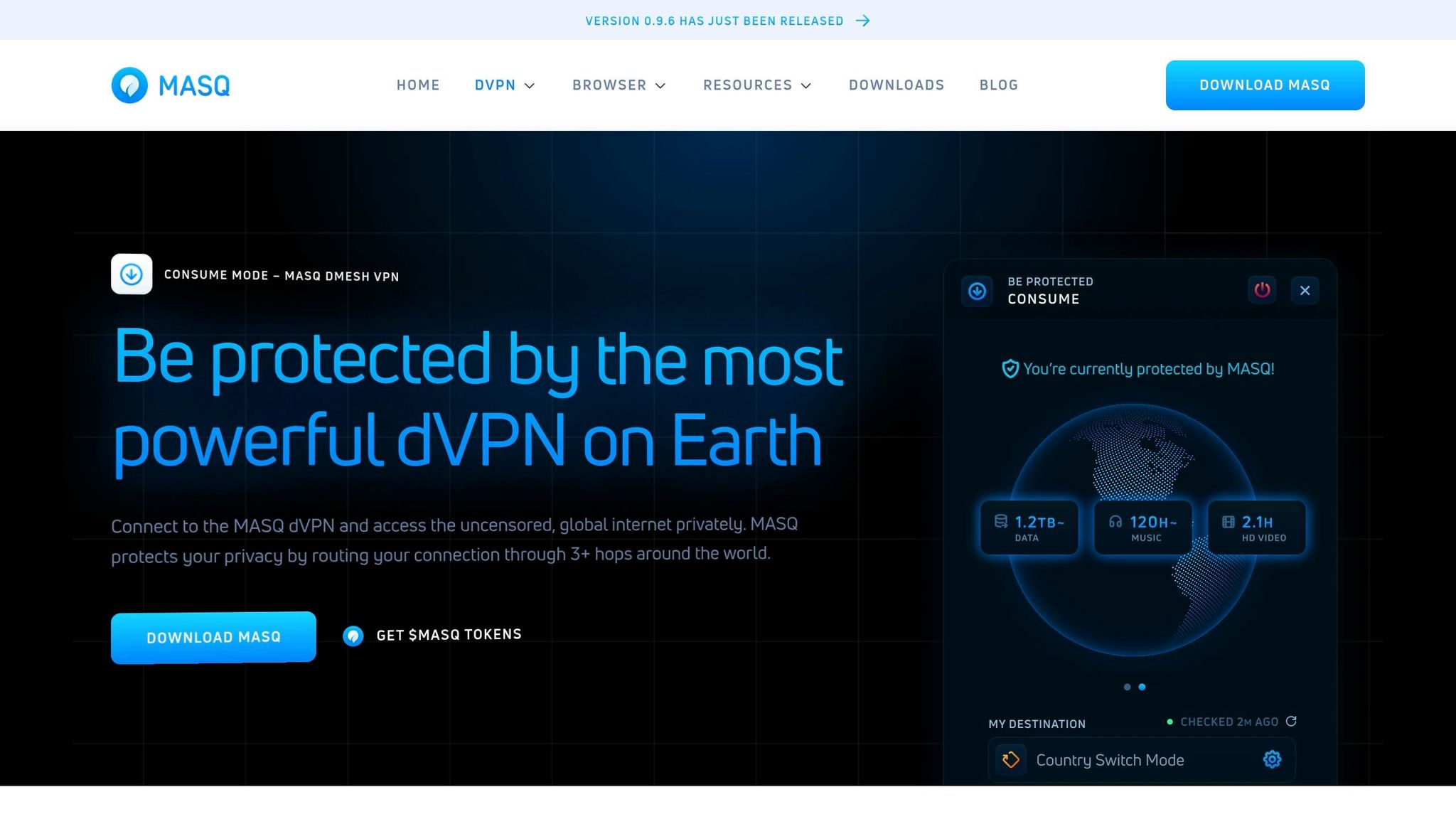
MASQ takes full advantage of these decentralized principles to create a powerful solution that bypasses traditional VPN detection methods. Launched in 2019, MASQ operates as a peer-to-peer network, offering multi-hop routing with up to 5 hops. This means your data passes through several independent nodes, making it nearly impossible to trace its origin or destination.
What sets MASQ apart is its reliance on residential IPs contributed by network participants, rather than data center IPs. This makes it much harder for platforms like Netflix to detect and block the traffic since they typically blacklist known VPN server ranges. Additionally, with no central authority in the network, there’s no centralized logging - eliminating the risk of data being stored or accessed.
Feature | Traditional VPN | MASQ (dVPN) |
|---|---|---|
Server Type | Centralized Data Centers | Decentralized User Nodes |
IP Type | Data Center IPs (Easily Blocked) | Residential IPs (Hard to Detect) |
Logging | Centralized (Risk of legal pressure) | None (No central authority) |
Routing | Single-hop (usually) | Multi-hop (1-5 hops) |
MASQ also integrates seamlessly into a privacy-focused browser that includes built-in tracker blocking and encrypted DNS. For those seeking extra privacy, users can opt for higher hop counts (3-5 hops), which add more layers of encryption. The network runs on a pay-as-you-go system using $MASQ tokens, with premium plans starting at $8 per month for additional features.
How to Stay Informed and Reduce Risks
Monitor Netflix Terms of Service Updates
Netflix regularly updates its Terms of Use to address concerns from content distributors about users bypassing regional licensing agreements. Pay close attention to sections 4.3 and 4.6, which cover geographical restrictions and content protection measures. While Netflix primarily enforces these rules through technical means - like blocking specific IP ranges - it does reserve the right to terminate accounts for repeated violations. For most users, this enforcement takes the form of error messages like M7111-1331-5059 ("Proxy detected") rather than outright account bans.
Choose Privacy-Focused Tools
The VPN you select plays a big role in reducing detection risks. MASQ VPN Network is a standout option because it routes traffic through residential IP addresses provided by its network participants. These addresses mimic regular home internet connections, making them much harder for Netflix to identify and block. Additionally, MASQ's decentralized structure ensures there’s no central logging of your activity. Their Premium plan starts at $8 per month and works seamlessly with the MASQ Browser, which offers built-in tracker blocking and encrypted DNS.
To further protect your privacy, activate your VPN's kill switch and clear your cookies and cache. These steps help prevent IP leaks and any leftover location data. Always connect to your VPN before opening Netflix - logging in first can lock your session to your home region and trigger stricter detection measures.
While these tools can minimize risks, staying within legal boundaries is just as important.
Avoid Illegal Activities
It’s critical to avoid actions that cross legal lines. Using a VPN to access geo-restricted Netflix content exists in a legal gray area. While it violates Netflix's Terms of Use, it’s not considered a criminal offense in most places, including the U.S., UK, and Canada. However, activities like torrenting copyrighted material or distributing unauthorized content come with much higher legal risks. These actions can lead to statutory penalties, including hefty fines and potential legal action.
In some countries, like China, Russia, Iran, and the UAE, VPN usage itself is either banned or heavily restricted. If you’re in one of these regions, using a VPN could result in fines or even criminal charges. Always know your local laws before proceeding.
Conclusion
Using a VPN to access Netflix's geo-restricted content isn't a crime in major jurisdictions like the U.S., UK, or Canada. However, it does breach Netflix's Terms of Use, which could result in error messages or, in rare cases, account suspension. The key takeaway here is to make informed choices rather than focusing on the legal nuances already discussed.
To navigate these risks, it's important to stay updated on Netflix's Terms of Use - especially sections 4.3 and 4.6, which outline geographic restrictions. Opt for tools designed to prioritize privacy and reduce detection risks. For instance, the MASQ VPN Network offers a decentralized, peer-to-peer system with no central logging, making it much harder for platforms like Netflix to detect VPN traffic. Their premium plans start at $8 per month and work seamlessly with the MASQ Browser to enhance privacy.
It’s also crucial to separate contract violations from actual illegal actions. While bypassing geo-blocks breaches Netflix’s terms, activities like torrenting copyrighted material or distributing unauthorized content can lead to serious legal consequences, including fines and potential prosecution. Additionally, in certain countries like China, Russia, and the UAE, using a VPN itself may be legally restricted.
The bottom line? Understand the difference between a service agreement breach and a legal violation. Stick to tools like MASQ for privacy, stay informed about Netflix's policies, and always consider your local regulations to protect yourself while making smart, lawful decisions.
FAQs
Can Netflix ban my account for using a VPN?
Netflix has the right to restrict or even ban your account if it detects you're using a VPN, as this goes against its terms of service. While using a VPN itself isn't illegal, Netflix may block your access or take other measures if their systems pick up on VPN usage. It's important to weigh these risks carefully before attempting to bypass geo-restrictions.
Is using a VPN for Netflix illegal where I live?
Using a VPN to watch Netflix in the United States isn’t usually against the law. However, it might go against Netflix’s terms of service. This could lead to restrictions on your account. It’s a good idea to check Netflix’s policies to fully understand any potential consequences.
How can I reduce Netflix VPN detection and proxy errors?
To reduce the chances of Netflix detecting your VPN or encountering proxy errors, opt for a VPN that includes obfuscation features. These features help disguise VPN traffic, making it harder for Netflix to spot. Additionally, keep your VPN app up to date, try switching between servers in the same region, and select a well-known VPN provider that has a track record of working with Netflix. Since Netflix constantly improves its ability to detect VPNs, these practices can help you stay ahead of their efforts.