
Decentralized search is reshaping how we access information by removing the control held by a few corporations like Google and Microsoft. Today, 95% of all searches rely on centralized indexes, which are prone to manipulation, censorship, and privacy violations. These systems track your data, influence your views, and limit your access to unbiased information.
Decentralized search engines, like Timpi, offer an alternative by distributing control across independent nodes. They build their own indexes, ensuring transparency, privacy, and resistance to censorship. With no tracking or profiling, decentralized platforms provide unfiltered access to knowledge, free from corporate or political agendas.
Key takeaways:
Centralized search issues: Biased results, data tracking, and censorship.
Decentralized benefits: Privacy, transparency, and unbiased results.
Example: Timpi independently indexes billions of pages weekly using a global network of nodes.
The future of search lies in decentralization, giving you control over your online experience.
Problems with Centralized Search Engines
Hidden Algorithms and Manipulated Results
Traditional search engines, like those powered by algorithms such as PageRank, often favor well-established, highly connected websites. This setup gives large, well-funded organizations a significant advantage, pushing independent or smaller voices to the margins. A 2019 investigation by The Wall Street Journal revealed that Google executives manually adjusted algorithms and autocomplete suggestions to benefit major advertisers and their own services. Journalist Andreas Ekström summed it up perfectly when he said:
"Behind every algorithm is a person with a moral code."
Adding to this, personalization features - based on your search history, location, and demographics - create "filter bubbles." These bubbles limit the variety of perspectives you’re exposed to, reinforcing existing views and narrowing your worldview. This manipulation isn't just about controlling information; it also opens the door to deeper privacy violations as user data becomes a tradable asset.
Privacy Invasion and Data Monetization
Centralized search engines collect massive amounts of personal data. Every query you make is logged, along with your IP address, browser cookies, search terms, and unique identifiers. If you're logged in, your searches are tied to your broader digital profile, making it easier for these platforms to extract data across multiple services.
This data isn't collected for your benefit - it’s sold. As Harvard Professor Shoshana Zuboff explains:
"Users aren't the customers - they're the raw material. The product being sold is your future behavior."
This business model, often referred to as Surveillance Capitalism, prioritizes data extraction and user engagement over your privacy. The constant tracking of user behavior supports a system that not only profits from your information but also enables tighter control over what you see and access online.
Censorship and Restricted Access
Centralized search engines also enable censorship. Whether due to internal policies or legal demands, content can be de-ranked or outright removed, often with little to no transparency.
The August 2024 U.S. antitrust ruling against Google revealed how the company used exclusive agreements and advertising practices to maintain an illegal monopoly over search. The court found that Google actively stifled competition and controlled the flow of information, ultimately requiring the company to allow competitors access to its search index.
Studies have shown that biased search rankings can sway undecided voters by as much as 20%. This level of influence, combined with opaque algorithms and centralized control, highlights the urgent need for more transparency and accountability in how search engines operate.
How Decentralized Search Protects Information Freedom
Independent Indexing and Community Control
Decentralized search creates its own index using independently operated nodes, cutting ties with Big Tech's centralized data dominance. As Martin Carlill, Marketing & GTM Director at Timpi, puts it:
"If your search engine relies on Big Tech's index, it also inherits their biases, commercial agendas, and privacy tradeoffs - even if the interface looks different."
Instead of depending on centralized data centers owned by a single corporation, decentralized platforms use distributed networks of nodes to crawl and store web data. This setup eliminates any single authority over what gets indexed and how it's ranked. Currently, only four major players - Google, Bing, Yandex, and Baidu - control large-scale independent web indexes. However, decentralized alternatives are challenging this grip by transferring indexing power to communities. This shift not only diversifies control but also strengthens resistance to censorship.
Censorship Resistance Through Distributed Networks
By spreading search infrastructure across thousands of independent nodes worldwide, decentralized systems make censorship nearly impossible. Without a central server, there’s no single point of failure, no company to pressure, and no backroom deals deciding what content can or cannot be seen.
"Because no single party controls the infrastructure or the data, it's nearly impossible for governments or corporations to suppress information across the entire system."
This distributed design ensures resilience. By routing searches through various nodes, it becomes incredibly difficult to profile users or track their activities. This approach not only blocks undue influence but also empowers users with control over their access to information. Beyond censorship resistance, decentralized networks prioritize user privacy at every turn.
Privacy by Design
Protecting privacy is a core principle of decentralized search. Unlike traditional search engines, which collect user queries, IP addresses, and browser data to fuel advertising models, decentralized systems operate differently. By using peer-to-peer protocols and independently run nodes, they maintain user anonymity.
"With no centralized entity collecting your data, decentralized platforms can genuinely respect user privacy without loopholes or fine print." - Martin Carlill, Marketing & GTM Director, Timpi
The technology proves it works. Decentralized networks can crawl over 3 billion web pages weekly without storing any user data. During tests, distributed node networks even indexed over 5 billion pages in just 48 hours, showing that privacy doesn’t have to come at the cost of performance.
Timpi Search: A Decentralized Alternative
Independent Index for Unbiased Results
Timpi is rewriting the rules of search by building its own independent web index, storing and crawling billions of pages without relying on Big Tech infrastructure. This sets it apart from other privacy-focused search engines that still lean on the same centralized systems.
"Timpi isn't a wrapper around someone else's data. We've built our own independent index from scratch. And we've done it using a decentralized network, which no one else has done at scale." - Martin Carlill, Marketing & GTM Director, Timpi
The scale is impressive. Timpi processes and indexes over 3 billion pages weekly, making it one of just five global entities with a large-scale independent index. Joining the ranks of Google, Bing, Yandex, and Baidu, Timpi stands out as the only decentralized option.
This independence allows Timpi to provide search results free from commercial or political interference. There are no hidden algorithms prioritizing paid content or suppressing viewpoints that don't align with corporate interests. Instead, the focus is purely on relevance and fairness.
This unbiased approach is backed by a governance model that prioritizes transparency and community involvement.
Community-Powered and Transparent
Timpi's infrastructure operates on a decentralized network of over 1,000 nodes spread across six continents. These nodes - classified as Collector, Guardian, and GeoCore - are run by individuals, not corporate data centers. The entire process of crawling and indexing is coordinated by the Timpi Autonomous Protocol (TAP).
What truly sets Timpi apart is its community-driven governance model, known as the Timpi Autonomous Government (TAG). This system empowers the community to shape ranking logic and content standards, moving away from the opaque algorithms controlled by traditional search engines. Contributors, including node operators and curators, can even earn $TIMPI tokens for their efforts in maintaining the network and ensuring data integrity.
This level of transparency ensures users can trust that the search engine is free from hidden agendas or corporate manipulation. It’s a system built on openness, seamlessly connecting with the MASQ ecosystem.
Part of the MASQ Ecosystem
Timpi integrates directly with the MASQ Browser and MASQ VPN Network, offering a fully private online experience. When you search with Timpi through MASQ, your queries are routed via a decentralized VPN network that doesn’t log your activity. Neither the browser nor the search engine collects any user data.
This partnership creates a seamless environment where browsing, searching, and internet traffic are free from centralized tracking or data sales. Additionally, the MASQ ecosystem offers native support for Handshake decentralized domains, providing access to censorship-resistant content that mainstream browsers often block.
"We're building a future where search is decentralized, censorship-resistant, and truly belongs to the people." - Martin Carlill, Marketing & GTM Director, Timpi
With 95% of all internet searches currently relying on Google or Microsoft indexes, Timpi offers a real alternative. It combines privacy, performance, and independence, ensuring that information freedom isn’t compromised by centralized control. This integration is a step toward a freer, more open internet.
The Future of Search: Decentralized & Uncensored
The MASQ Ecosystem: A Complete Privacy Solution
The MASQ ecosystem is designed to counter centralized control and empower users with tools for online sovereignty. It combines private browsing, a decentralized VPN, and integrated search to create a seamless privacy-focused experience.
MASQ Browser: Privacy-First Browsing
The MASQ Browser, built on Chromium, offers a familiar user experience while prioritizing privacy by default. It blocks ads, cross-site trackers, scripts, and prevents fingerprinting and profiling automatically - no extra setup needed.
This browser also comes with built-in Web3 capabilities, including support for multi-chain wallets, ENS domain resolution, and direct access to IPFS URLs. A unique feature, MASQ Spaces, allows you to manage and switch between decentralized applications and browser profiles effortlessly, keeping anonymous sessions separate from personal accounts.
In addition to these features, the MASQ Browser integrates directly with Timpi Search, ensuring that your browsing and search activities remain entirely within the privacy-focused ecosystem. Together with the MASQ VPN network, this creates a unified solution for private and secure online activity.
MASQ VPN Network: Decentralized and Log-Free
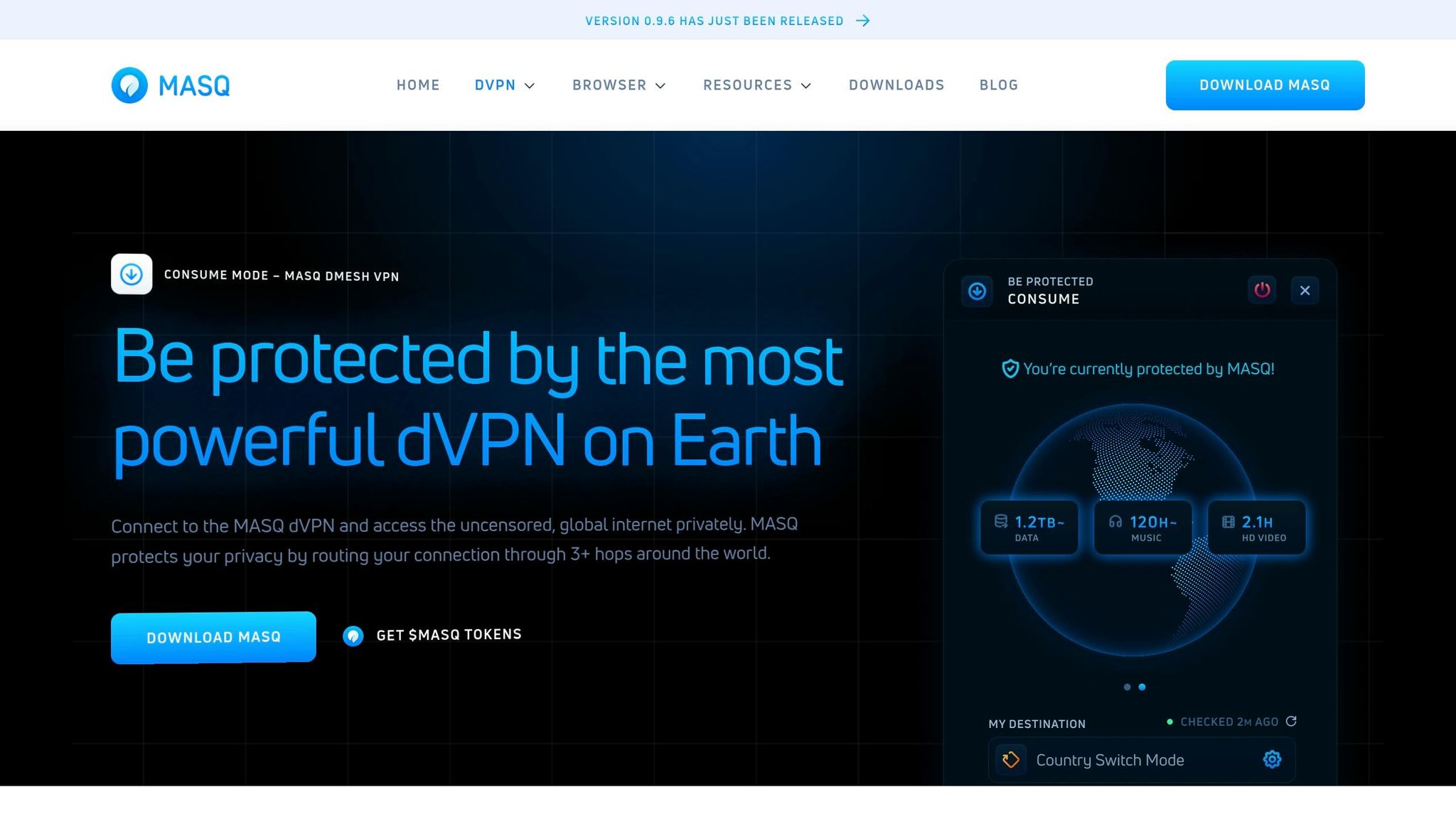
The MASQ VPN Network enhances online privacy by decentralizing how your data is routed. Instead of relying on centralized servers, this peer-to-peer mesh network routes traffic through user-operated nodes. This eliminates single points of vulnerability, such as logging or compliance with data requests.
By routing traffic through residential IPs, the network makes censorship and tracking far more difficult. It also supports multi-hop routing (up to 5 hops), adding another layer of complexity to tracing your activity. During beta testing, the network achieved a 90% to 100% connection success rate for users on Windows and updated macOS devices.
Security is further reinforced with Transport Layer Security (TLS) and AES-256 encryption, ensuring your data remains safe - even if a node is compromised. Additionally, you can contribute to the network by sharing unused bandwidth (minimum 20Mbps upload speed required) and earn $MASQ tokens in return. This not only offsets costs but also helps expand the network.
Timpi Search Integration
Timpi Search completes the MASQ ecosystem by integrating seamlessly into its framework. When you search through MASQ using Timpi, your queries are routed via the decentralized VPN network. This ensures zero logging - neither the browser nor the search engine retains any user data.
Timpi also supports Handshake decentralized domains, reinforcing the ecosystem’s stance against censorship. This isn't just a private search engine or browser; it's a fully integrated system designed to give you complete control over your online presence.
Benefits of Switching to MASQ
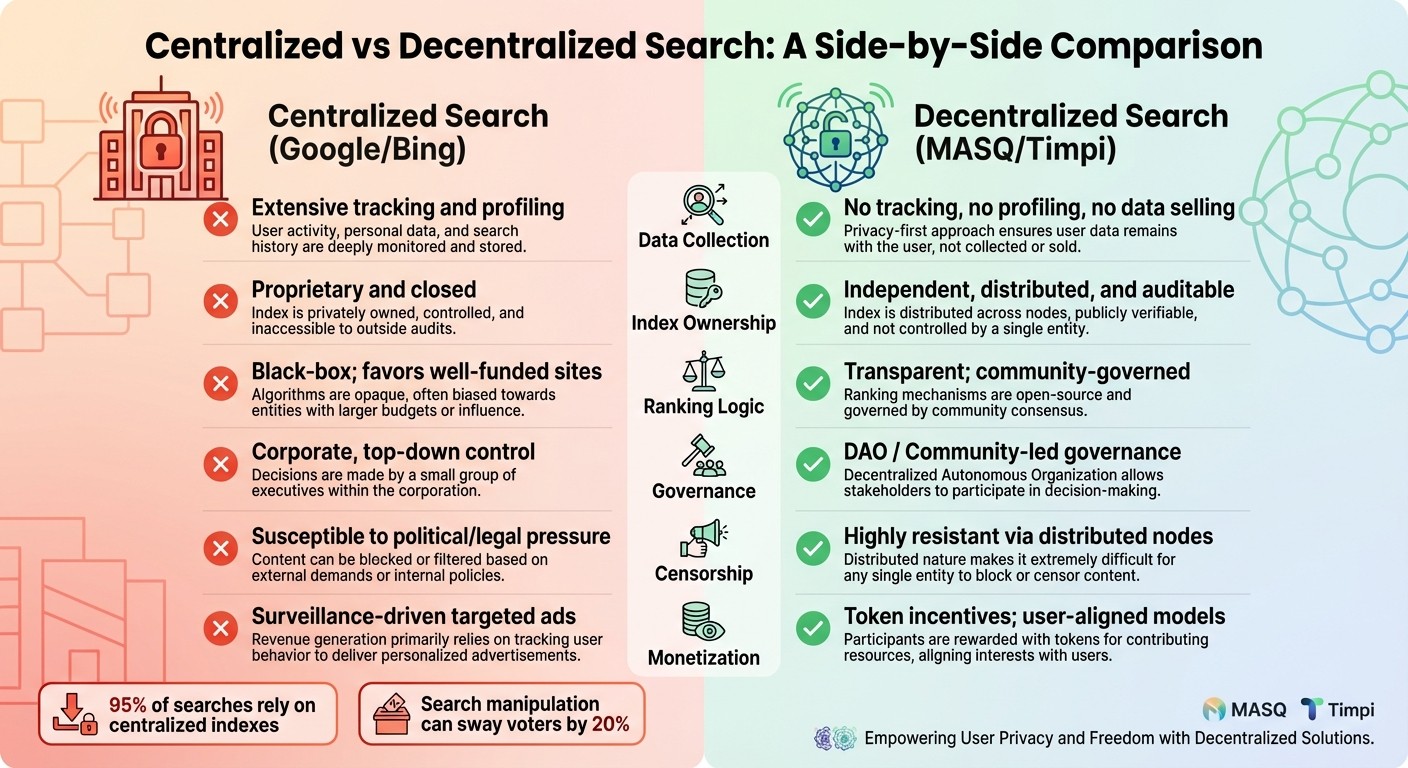
Centralized vs Decentralized Search Engines Comparison
Privacy and Freedom from Manipulation
MASQ takes a decentralized approach, offering practical privacy benefits for everyday users.
With MASQ, your searches stay private - no tracking, profiling, or data selling. Unlike centralized platforms that compile detailed digital profiles to sell to advertisers, MASQ operates without surveillance systems.
It also tackles algorithmic bias. Using Timpi's independent index, MASQ removes manipulated rankings, which studies show can sway undecided voters by up to 20%.
The platform's distributed network ensures that no single entity - be it a government or corporation - can censor information across the system. Multi-hop routing makes tracing your online activity nearly impossible, while the independent index shields you from the commercial and political agendas of Big Tech.
Centralized vs Decentralized Search Comparison
Feature | Centralized Search (Google/Bing) | Decentralized Search (MASQ/Timpi) |
|---|---|---|
Data Collection | Extensive tracking and profiling | No tracking, no profiling, no data selling |
Index Ownership | Proprietary and closed | Independent, distributed, and auditable |
Ranking Logic | Black-box; favors well-funded sites | Transparent; community-governed |
Governance | Corporate, top-down control | DAO / Community-led governance |
Censorship | Susceptible to political/legal pressure | Highly resistant via distributed nodes |
Monetization | Surveillance-driven targeted ads | Token incentives; user-aligned models |
This table highlights the stark contrast between centralized and decentralized search, showing how MASQ prioritizes user privacy and transparency.
Simple and User-Friendly
MASQ makes decentralized technology accessible through a user-friendly interface. Built on Chromium, the browser feels familiar right from the start. There’s no complicated setup or technical know-how required - privacy features are enabled automatically.
Everything you need is integrated into one platform. The browser, decentralized VPN, and independent search work together effortlessly, so you don’t have to toggle between multiple apps or deal with complex configurations.
Even trying MASQ is hassle-free. The free trial doesn’t require an account or personal information, letting you browse privately right away. For those seeking advanced features, MASQ Premium starts at $8/month, with payment options that include credit cards and Web3 methods. This approach ensures your identity stays completely separate from your browsing activity.
Conclusion: Take Back Control with Decentralized Search
In 2026, the freedom to access information isn't just idealistic - it's essential. With 95% of searches controlled by centralized indexes, and the ability to manipulate search results influencing voter behavior by up to 20%, the urgency for change is undeniable. Centralized search engines have shifted from being gateways to becoming gatekeepers.
Decentralized search offers a way out. By spreading control across a network of independent nodes, platforms like Timpi ensure that no single corporation or government can suppress or manipulate information. This approach transforms search from a controlled experience into one of unrestricted access.
The evolution of search technology doesn't stop there. Solutions like MASQ integrate a privacy-focused browser, a decentralized VPN, and independent search capabilities into one seamless experience. No tracking. No profiling. No hidden algorithms. Just pure, unfiltered access to the internet as it was originally intended.
The move toward sovereignty in tech has already begun. Taking part is as easy as switching tools. Download MASQ today and try it for free - no account or personal details required. For $8/month, MASQ Premium offers the complete privacy package, with payment methods designed to keep your identity separate from your online activity.
Your journey toward digital freedom starts with one choice: take control of your online experience.
FAQs
How does decentralized search stop censorship?
Decentralized search works by spreading the responsibility for indexing and retrieving information across multiple independent nodes, rather than relying on a single centralized authority. This approach removes a central control point, making it much tougher for anyone to manipulate or censor content. By distributing data across a network, decentralized systems not only improve resistance to censorship but also safeguard user privacy. They ensure open and unbiased access to information, giving users more control and preserving digital freedom.
Does Timpi store or track my searches?
Timpi ensures your searches remain completely private by not storing or tracking them. This means your online activity stays confidential, without any surveillance or interference.
What do I need to use Timpi with MASQ?
To start using Timpi with MASQ, simply link your Timpi decentralized search account. Timpi operates on its own decentralized network, offering access to information that’s free from filtering or censorship. It also prioritizes user privacy and control. By connecting your account, you not only preserve the freedom to access information but can also earn rewards for being an active participant.