Decentralized VPNs (dVPNs) offer a new way to combat internet censorship by routing traffic through user-operated nodes instead of centralized servers. Unlike conventional VPNs, which are vulnerable to government blacklists and centralized control, dVPNs like MASQ create a distributed network that is much harder to block or monitor. This makes them ideal for bypassing restrictions in heavily censored regions like China, Iran, and Russia.
Key Features of dVPNs:
Distributed Network: Traffic is routed through residential IPs, avoiding detection.
Multi-Hop Routing: Data passes through multiple nodes, increasing anonymity.
Web3 Integration: Tools like built-in wallets and access to decentralized applications.
Incentives: Users can earn tokens by sharing bandwidth.
MASQ stands out by combining dVPN technology with privacy-focused browsing and Web3 tools. It blocks trackers, supports encrypted DNS, and offers customizable routing for enhanced security. With MASQ, users can bypass censorship, protect their privacy, and access decentralized applications - all while participating in a self-sustaining network.
To get started, download the MASQ browser, select your routing preferences, and enjoy unrestricted, private internet access.
How Internet Censorship Works and Why Centralized VPNs Fail
Common Internet Censorship Methods
Governments and internet service providers (ISPs) employ a range of technical methods to restrict access to websites and online services. One of the simplest techniques is IP blocking, where specific server addresses are blacklisted at the ISP or national gateway level. This is a cornerstone of China's Great Firewall, effectively cutting off access to targeted servers entirely.
Another method, DNS tampering, intercepts website requests and either returns no address or redirects users to government-approved pages. China heavily relies on DNS poisoning to control online activity. While encrypted DNS services like Cloudflare's 1.1.1.1 can sometimes bypass this, authorities are increasingly cracking down on these alternatives.
For more advanced censorship, Deep Packet Inspection (DPI) is used. This technology scans the content and patterns of internet traffic to detect VPN protocols, specific applications, or even banned keywords. Once identified, traffic can be throttled or blocked entirely. China's Great Firewall takes this a step further with active probing, where suspected VPN or Tor servers are tested automatically. If confirmed, these servers are swiftly added to a blocklist.
VPN blacklists are another common tactic. Governments compile lists of known commercial VPN server IPs and block them in bulk. Studies reveal that more than 80% of commercial VPN IPs are blacklisted in heavily censored regions within weeks of detection. By scanning for typical VPN ports and traffic patterns, authorities can disrupt major VPN services, forcing users to constantly switch servers or search for alternatives.
These censorship methods highlight the vulnerabilities of conventional VPNs.
Why Centralized VPNs Are Vulnerable
Centralized VPNs rely on fixed data center IPs, making them easy targets for identification and blocking. Unlike residential IPs, which are harder to ban without affecting regular users, data center IPs can be blocked en masse with minimal disruption. Governments use tools like traffic analysis, public server lists, or even commercial VPN-detection feeds - originally designed to combat VPN use for streaming - to maintain up-to-date blocklists.
Additionally, VPN protocols like OpenVPN and WireGuard have identifiable patterns that can be detected through DPI unless specifically obfuscated. Censors analyze packet sizes, timing, and handshake behaviors to flag and block these connections. For instance, over 90% of Tor's public relays are blocked in China using these techniques, and many commercial VPN servers face similar restrictions.
Russia has been blocking VPN services since 2017, with efforts ramping up significantly after 2022. Iran has taken a different approach by throttling encrypted traffic altogether during times of unrest, slowing down VPNs, messaging apps, and secure web browsing simultaneously. According to Freedom House's "Freedom on the Net 2024" report, internet freedom has declined for the 14th year in a row, with at least 41 countries blocking social media or communication platforms in the past year.
While the technical vulnerabilities of centralized VPNs are concerning, their organizational structure poses an even greater risk.
The Core Problem: Centralized Control
When a single company manages all VPN servers, it creates an easy target for both technical and legal pressure. This centralized setup allows governments to exert significant control. For example, Russia has not only ordered ISPs to block specific VPN services but has also demanded that some providers connect to government blacklists - effectively turning these VPNs into tools for censorship. Even providers committed to user privacy can be forced to log and share user data or face shutdown.
This centralized infrastructure, while convenient for setup and management, is also what makes these VPNs so vulnerable. It becomes a double-edged sword - easy to operate but just as easy for authorities to identify, block, and manipulate.
How Decentralized VPNs Fight Censorship
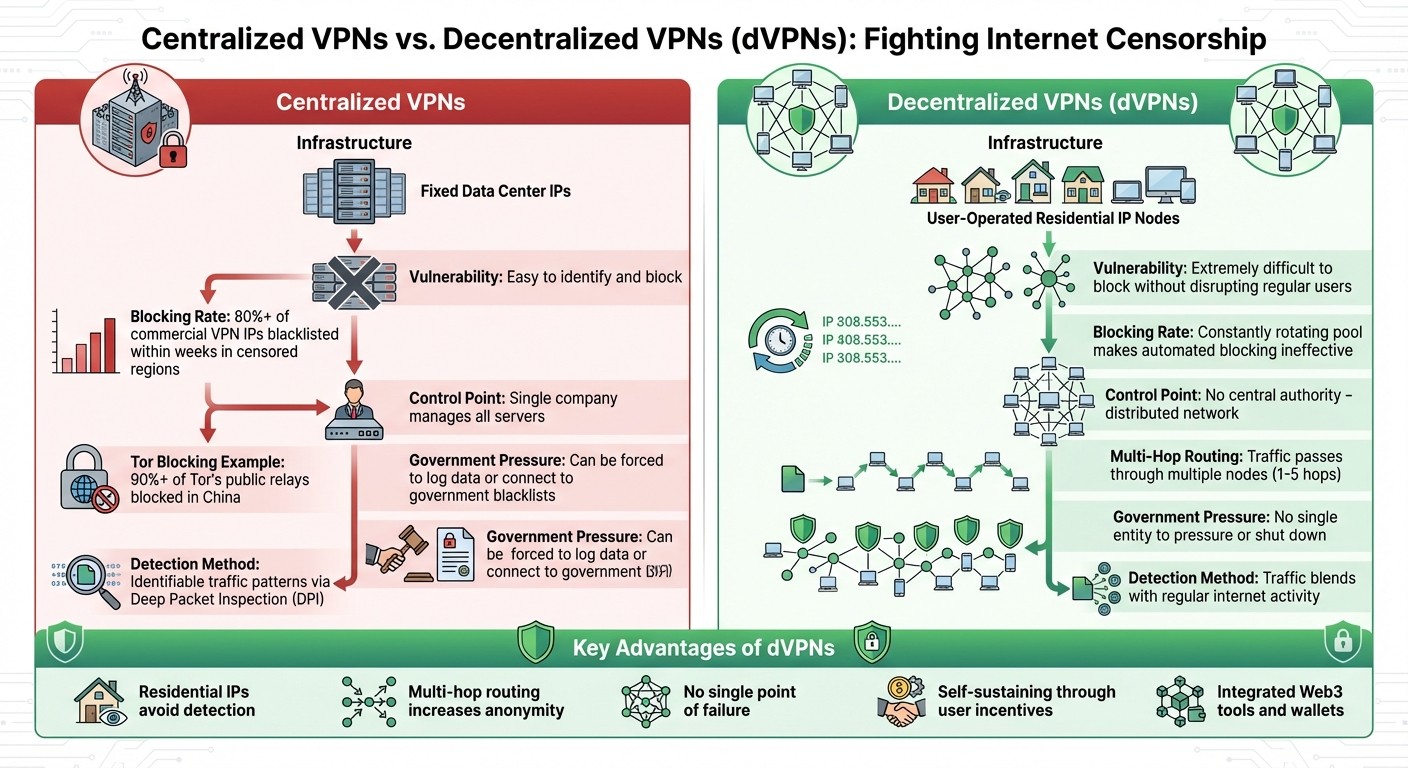
Centralized VPNs vs Decentralized VPNs: Key Differences in Fighting Censorship
What Decentralized VPNs Are
Decentralized VPNs (dVPNs) operate through a network of user-run nodes instead of centralized data centers, removing single points of failure. Essentially, users share their internet connections to create a global, decentralized network that’s much harder for governments to target or control.
Because there’s no single company managing fixed servers or IP addresses, there’s no central authority that can be pressured or shut down. The system thrives on user participation, making it incredibly difficult to dismantle. This decentralized design is the cornerstone of their ability to resist censorship.
Features That Make dVPNs Censorship-Resistant
The way dVPNs distribute traffic across a network of residential IP addresses provides a major advantage against censorship. Unlike traditional VPNs that rely on data center servers, dVPN traffic blends in with regular internet activity. Blocking such traffic would require identifying and restricting individual home connections - an effort that could disrupt ordinary users and create significant political and technical challenges.
Another key feature is multi-hop routing. Instead of connecting directly to a single exit node, dVPNs route data through several intermediate nodes, creating a complex, zigzagging path. Each additional hop makes it harder to trace the origin of the traffic or block the connection effectively.
Additionally, the use of diverse residential IPs makes automated blocking systems less effective. These IPs don’t follow the predictable patterns of data center traffic, making them much harder to identify and restrict.
MASQ as a Decentralized VPN Solution
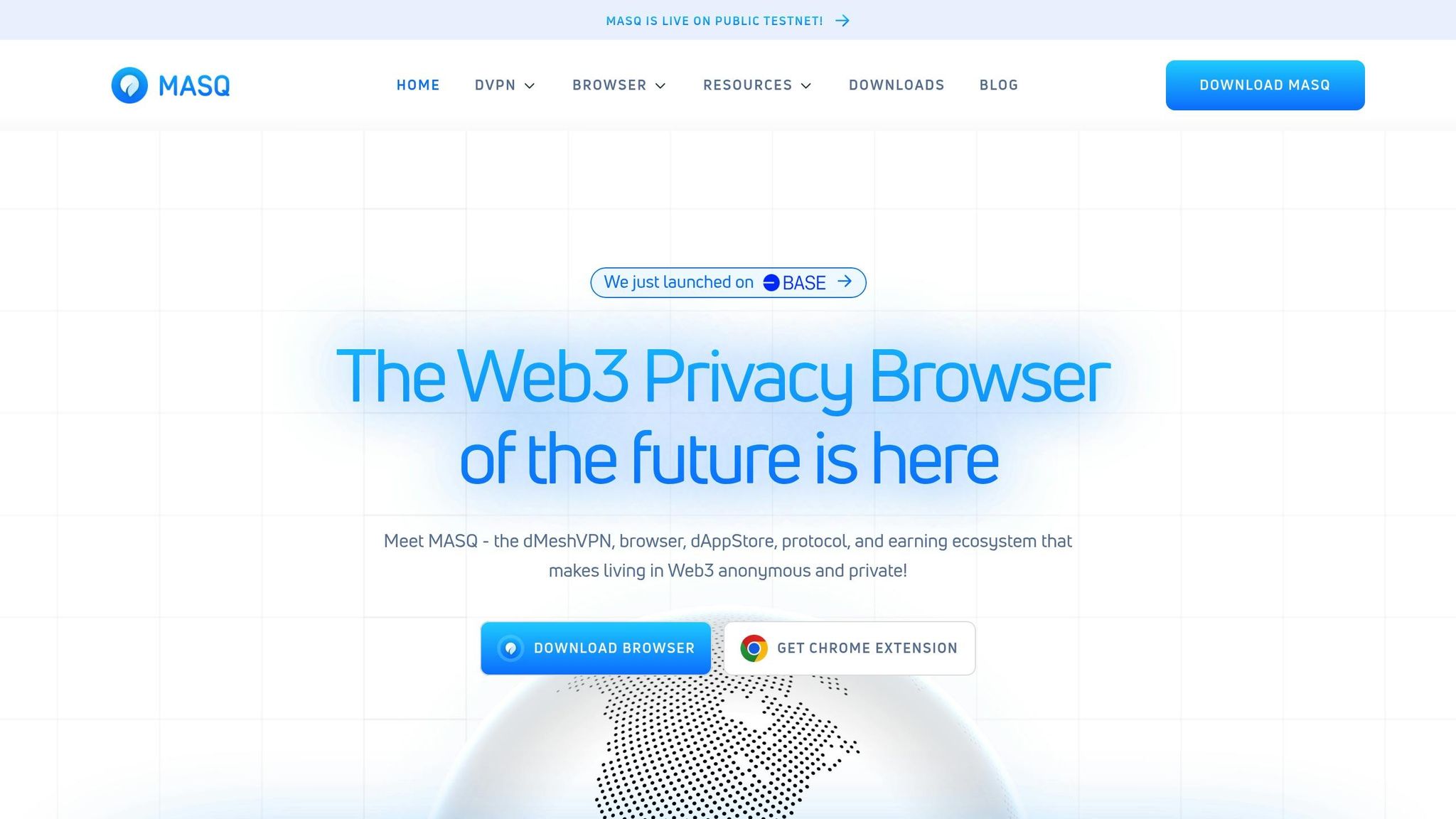
MASQ builds on this resilient, decentralized framework, offering a powerful tool to combat censorship. It combines dVPN technology with Web3 privacy features, enabling multi-hop routing, blocking ads and trackers, and protecting users from detection.
MASQ goes further by integrating Web3 tools, such as built-in wallets and support for ENS domains and IPFS URLs. This allows users to access decentralized applications and content that might otherwise be inaccessible. Security levels are customizable, ranging from basic 1-hop connections to advanced 5-hop routing for greater anonymity [1].
One of MASQ’s standout features is its incentive system. Users earn MASQ tokens by sharing their internet bandwidth with the network. This creates a self-sustaining ecosystem where increased participation strengthens the network, making it even more resistant to censorship [1].
How dVPNs Enable Internet Freedom and Web3 Access
Bypassing Geographic and Political Blocks
Decentralized VPNs (dVPNs) offer a powerful way to bypass geographic restrictions and government censorship. By routing your internet traffic through a global network of nodes, they make it harder for authorities to trace your connection or block your access. MASQ takes this a step further with its multi-hop routing, which obscures your actual location, ensuring your online activities remain private and unrestricted.
One standout feature of MASQ is its Country Selection tool, which lets you appear as if you're browsing from different countries. This is particularly useful for bypassing location-based restrictions. Studies on internet censorship reveal that tools like VPNs, Tor, and proxies are essential in heavily censored regions such as China, Iran, Russia, and Turkey. Governments in these areas frequently update their methods to block VPNs, particularly those using centralized IP addresses tied to data centers. Unlike traditional VPNs, decentralized VPNs like MASQ avoid this vulnerability by rotating traffic through a constantly changing pool of nodes, making it far more challenging for censors to block access. Beyond just bypassing restrictions, MASQ’s advanced routing also protects your data from intrusive tracking.
Protecting Privacy from ISP Tracking and Surveillance
Your internet service provider (ISP) has the ability to monitor your online activity - every website you visit and every search you make. dVPNs counter this by preventing ISPs from compiling detailed profiles of your behavior. MASQ enhances your privacy with its multi-hop routing system and a commitment to privacy-first practices. By routing your connection through multiple layers, MASQ significantly reduces the risk of ISP tracking. On top of that, the MASQ browser automatically blocks ads, cross-site trackers, and cookie tracking, cutting off the data streams that advertisers and other third parties rely on.
For even greater protection, pairing your dVPN with encrypted DNS (such as DNS over HTTPS or TLS) is highly recommended. Without encrypted DNS, ISPs can still see the domain names you query, even if they can’t access the specific content. Security experts emphasize that no-logs VPNs with strong encryption, when used alongside encrypted DNS and other privacy tools, remain some of the most effective ways to bypass censorship and protect your data. This secure and private setup also creates a solid foundation for accessing Web3 services.
Accessing Web3 Applications Without Restrictions
MASQ goes beyond privacy and censorship circumvention by integrating Web3 tools directly into its platform. Thanks to its decentralized structure, MASQ not only bypasses restrictions but also provides a seamless gateway to Web3 applications. With built-in Web3 wallets supporting multiple blockchains, native ENS domain resolution, and direct access to IPFS URLs, MASQ makes interacting with decentralized technologies straightforward. Its decentralized dApp store further simplifies discovering and using Web3 applications, while MASQ Spaces helps you organize and switch between your decentralized apps with ease. This integration ensures that users can explore the Web3 ecosystem without interference or limitations.
Getting Started with Decentralized Privacy Tools
MASQ offers powerful anti-censorship features, making it easier than ever to set up and maintain your online privacy. Here's how to get started.
How to Set Up and Use MASQ
First, download the MASQ browser from masqbrowser.com. You can choose between two plans: the Pay as You Go option, which uses $MASQ tokens for 1- or 3-hop routing, or the premium subscription ($8/month billed annually or $14/month) for up to 5-hop routing and faster speeds.
Once installed, enable dVPN mode and select your preferred hop count. Higher hop counts provide stronger anonymity, though they may slightly reduce speed. The browser comes equipped with pre-integrated Web3 wallets, so you can immediately access decentralized applications without needing extra extensions. Additionally, MASQ blocks ads and cross-site trackers by default, offering instant privacy protection as soon as you start browsing.
To confirm your privacy setup, activate your dVPN connection and visit a site like ipleak.net. This will verify that your IP address and DNS are hidden and reflect your chosen region instead of your home ISP's location.
Best Practices for Maintaining Privacy
Using a dVPN like MASQ is a great start, but maintaining privacy requires ongoing effort. Keep your MASQ browser, operating system, and other apps updated to fix security vulnerabilities that could be exploited by censors or trackers. Use a trusted password manager to create unique, strong passwords for every account, and enable multi-factor authentication on essential services.
For sensitive activities, create separate browser profiles to avoid linking anonymous browsing with personal accounts. Enhance your privacy further by using encrypted DNS (such as DNS-over-HTTPS or DNS-over-TLS) alongside your dVPN to prevent your ISP from seeing the domains you visit. After updates or configuration changes, re-test for IP, DNS, and WebRTC leaks to ensure your privacy settings remain effective.
By following these steps, you can maximize the benefits of MASQ's decentralized design, avoiding the single points of failure that traditional VPNs often face.
Why Decentralized Tools Solve Centralized Problems
Traditional VPNs often have centralized servers, creating vulnerabilities. Governments can pressure these companies to hand over logs, block their server IPs, or shut them down entirely. MASQ's decentralized network eliminates these risks by relying on a constantly shifting pool of independent nodes that no single entity controls.
Premium plans with multi-hop routing (up to 5 hops) add extra layers of anonymity, making it nearly impossible to trace your connection. With integrated Web3 wallets and access to a decentralized dApp store, MASQ delivers unrestricted browsing for both traditional websites and the growing Web3 ecosystem - all without depending on centralized systems that can be compromised or controlled.
FAQs
How do decentralized VPNs provide better privacy than centralized ones?
Decentralized VPNs take privacy to the next level by routing your internet traffic through a network of distributed nodes rather than relying on a single, central server. This approach makes it significantly more difficult for anyone to track, monitor, or restrict your online activities.
Traditional, centralized VPNs often come with risks like data logging or potential breaches. In contrast, decentralized systems distribute their functionality across multiple users, removing these vulnerabilities. This setup keeps your data private and secure, providing a stronger way to bypass censorship and maintain your online freedom.
Why is it difficult for governments to block decentralized VPNs?
Governments face a tough task when it comes to blocking decentralized VPNs (dVPNs), and it all boils down to how these systems are built. Unlike traditional VPNs that rely on central servers, dVPNs work on a decentralized network, meaning there’s no single point to target or shut down.
One standout feature of dVPNs is their multi-hop routing system. This system sends user traffic through multiple nodes located in different parts of the world. The result? Enhanced privacy and a much harder time for anyone trying to trace or block specific connections. On top of that, dVPNs often employ advanced encryption techniques and dynamic routing. These tools are designed to sidestep traditional censorship measures, giving users continued access to restricted content while safeguarding their privacy online.
How does MASQ use Web3 tools to enhance user experience?
MASQ integrates Web3 tools to deliver a smooth and secure online experience. It comes with built-in Web3 wallets that work across multiple blockchains, making it convenient for users to engage with decentralized finance (DeFi) platforms and dApps. On top of that, users can earn MASQ tokens simply by sharing their internet bandwidth, actively participating in a decentralized digital economy.
The platform also features a censorship-resistant dApp store, allowing users to securely explore and use Web3 applications while safeguarding their privacy and promoting unrestricted internet access.